For a pentagon A1A2A3A4A5, let *ai denote the area of the "corner" triangle whose vertices are Ai* and its two neighbors.
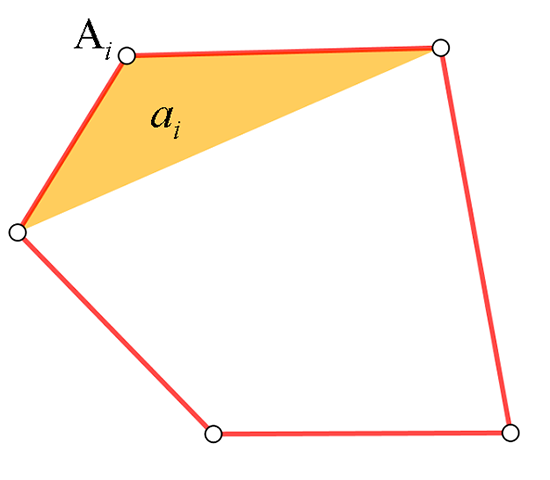
One of Gauss's corner triangles.
Gauss proved that the area of the pentagon is the larger root of the polynomial
x2 – sx + p, where s = a1 + a2 + a3 + a4 + a5 and p = a1a2 + a2a3 + a3a4 + a4a5 + a5a1.
For a regular pentagon, if a denotes the area of a corner triangle, then s = 5a,
p = 5a2, and so the area of the regular pentagon is where φ is the golden ratio.
This relation is in fact equivalent to the one attributed to Gaspard Monge:
a23a45 + a25a34 = a24a35, where *aij denotes the area of triangle A*1*AiAj*.
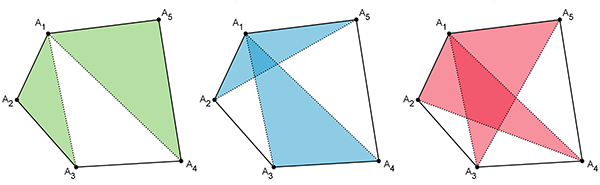
The triangles involved in Monge's formula.
The equivalence of the two formulas follows by observing that if the three vertices A1, *Ai, Aj are consecutive, then aij is one of the ai; otherwise, we have aij = A – ak – al, where A is the area of the pentagon and the distinct values (i, j, k, l) are taken from the set (2, 3, 4, 5). For example, a*34 = A – a2 – a5.
Monge's relation can, in turn, be proved using only elementary triangle-area formulas.