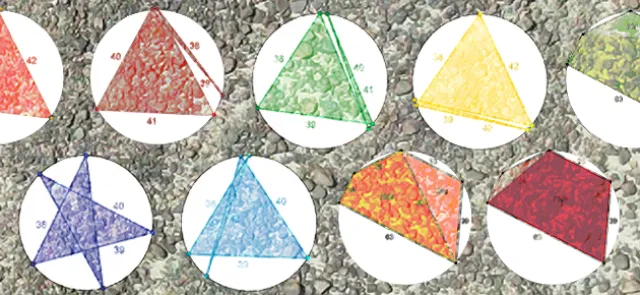
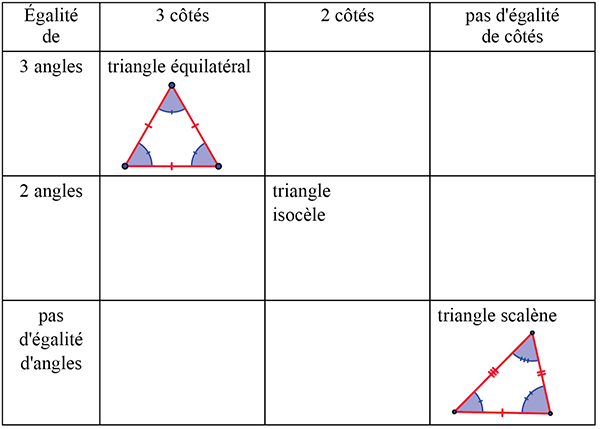
The simplest polygons to examine are, of course, triangles. A triangle may have three equal sides, exactly two, or none (see here). The same applies to its angles. Thus, a triangle may have three equal angles (equilateral), exactly two (isosceles), or none (scalene). Considering all the possibilities gives the table below. Of the nine cells, six correspond to impossible cases.
The 20 types of quadrilaterals
-----------------------------
Let us now try to generate every possible type of quadrilateral, considering only equal side lengths and equal angles and disregarding all other properties.
A quadrilateral may have four equal sides: it is then a rhombus, and possibly a square as a special case. It may have exactly three equal sides, with the fourth of a different length. It may instead have two pairs of equal opposite sides, in which case it is a parallelogram. It may also have two pairs of equal adjacent sides; it is a kite.