Before computers came to compete decisively with them, calculating prodigies were much sought after to perform truly astronomical calculations. They also delighted the courts of the powerful, or performed on stage. All had exceptional memories. Most of them, however, had no mathematical background at all. There are, of course, a few exceptions, such as Euler, Gauss, Riemann, Ramanujan, Erdős and Von Neumann. Gauss was correcting his father's accounts from the age of three, and János Von Neumann could calculate mentally faster than Fermi with his slide rule, or than Richard Feynman with his desk calculator — both Nobel laureates in physics. Note that the mathematicians who possessed great calculating ability all worked on numbers.
Spectacular calculators
-------------------------------
A few extraordinary cases of calculators have been recorded, such as Thomas Fuller, a slave in Virginia in the 18th century, but it was with the rise of circuses and shows of every kind in the 19th century that the number of calculating performers exploded.
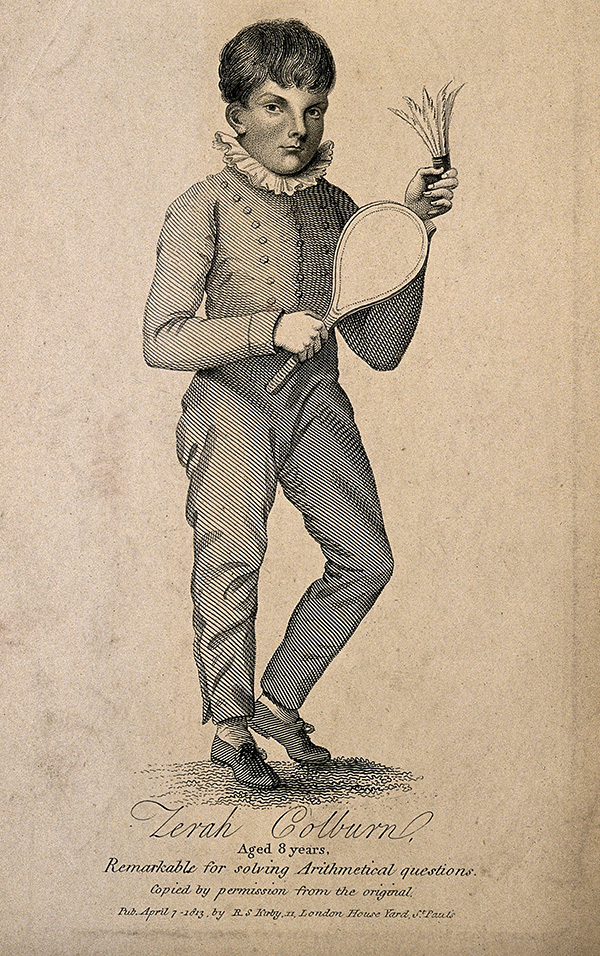
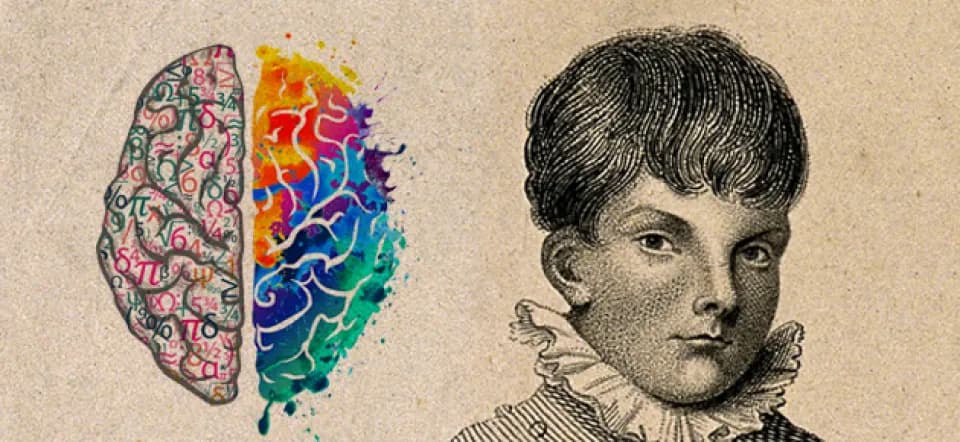
The first to become famous was Zerah Colburn (1804-1839). Was his talent primed by the family trait of having six fingers on each hand and six toes on each foot? Be that as it may, before he could read or count, he already knew the multiplication tables up to a hundred. His father, a humble farmer, saw in this a gift to exploit and took him to fairs at the age of six. Records of his performances exist from the age of eight. He could instantly multiply two four-digit numbers and only began to hesitate at five digits. Asked for the product of 21,734 and 543, he gave the answer almost at once: 11,801,562. How? Having noticed that 543 = 3 × 181, he first multiplied by 3, then by 181, which is — relatively — easier… Patrons funded his studies in Paris and then in London. He lost interest in such performances, however, and eventually returned to the United States at the age of twenty. He died of pneumonia at thirty-five.