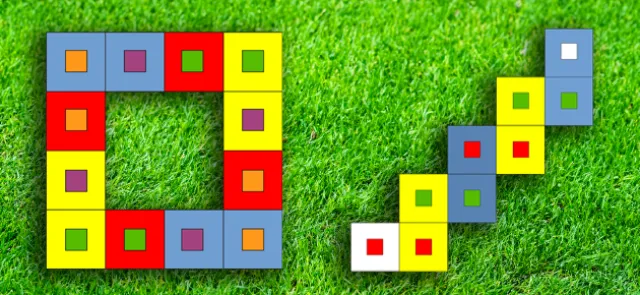
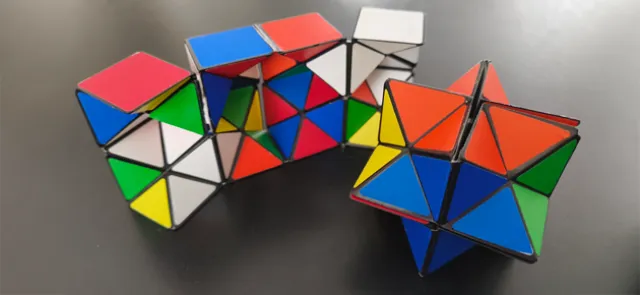
A flexagon can be seen as a polygon made up of small polygons stacked and hinged along their sides. These hinges allow the structure to be deformed — the polygon is flexible — so as to reveal different pairs of "faces" (the top and bottom of the polygon), following cycles.
When not being "flexed", hexaflexagons have stable hexagonal positions. They are made up of elementary equilateral triangles hinged to one another. A hexaflexagon can also be seen as a set of 6 stacks of triangles arranged in a hexagon. We will see how the distribution of triangles across each stack is linked to the number of stable positions of the object (represented, in this feature, by "faces" of different colors).
The simplest hexaflexagon is the trihexaflexagon (see the article "The short history of flexagons"). It can be assembled from a strip of 10 triangles (the two ends of which are glued onto one another, which actually amounts to only 9 triangles). By deforming this structure — by "flexing" it — the three different stable positions can be made to appear, hence the name.
However, by increasing the number of equilateral triangles in the starting strip, hexaflexagons with more than three different stable positions can be built. The winding that leads to the hexaflexagon is a Möbius strip if the number of stable positions is odd. It is a ring if that number is even.
Toward hexahexaflexagons
---------------------------