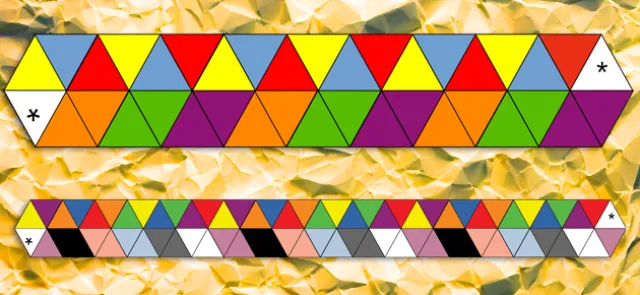
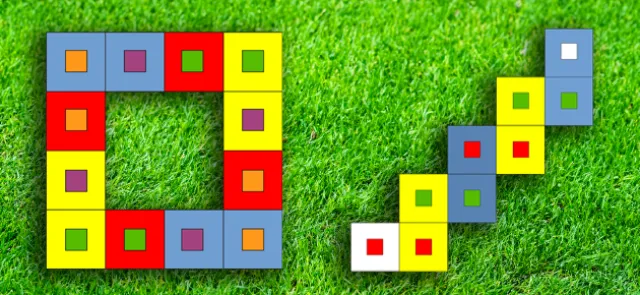
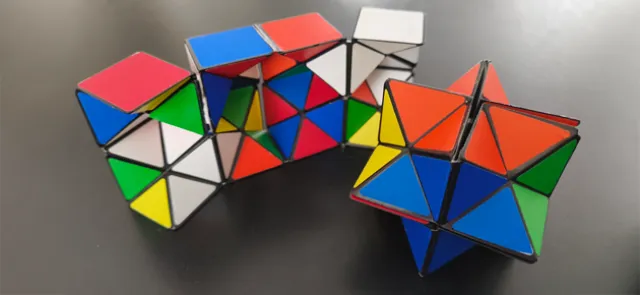
The December 1956 issue of the American popular-science magazine Scientific American carried the first article by Martin Gardner (1914-2010): Flexagons. The article had a considerable impact, and at the time it was not unusual to see someone in the streets of New York manipulating a flexagon—a practice we will from now on call "flexing." This enthusiasm led the publisher to entrust Martin Gardner with the magazine's "Mathematical Games" column, which he ran for more than twenty-five years, to great and well-known success. This was the starting point of a series of more than three hundred articles that popularized many mathematical concepts: the game of hex, polyominoes, the game of life, the RSA code...
Birth of an object
--------------------
By 1956, flexagons had already existed for almost twenty years, but they remained a curiosity known only to a few mathematicians. According to Martin Gardner, their story begins with Arthur H. Stone (1916-2000), then a student at Princeton (United States). Since he came from England, he owned English binders, and to fit his American notebook sheets into them he had to trim about an inch (25.4 mm) off the sheets. He amused himself with the strips he obtained this way. Stone, known for his manual dexterity, eventually built a flexagon.
The flexagon he obtained takes the form of a hexagon with three faces. Manipulating the object, which is made up of hinged equilateral triangles, reveals a third, hidden face in addition to the front and back. Readers are strongly encouraged to build one before exploring the rest of this feature (see box below).
Stone's flexagon is the simplest one to start out with in "flexology." Assembling the object (coiling a strip of 9 triangles the way you would a Möbius strip) and then manipulating it reveals the alternation of three "faces" of the hexagon. The 9 double-sided triangles give 18 triangular faces, which appear successively in groups of 6 (arranged in a hexagon). The object therefore always has 6 front triangular faces, 6 back triangular faces and 6 hidden triangular faces at any given time. Three colors are used to visualize the three sets of triangles.