



Amazing flexagons
Discovered by chance during the 20th century, flexagons are flat objects, generally made of paper, which, when unfolded, reveal hidden faces. They come in various shapes and different levels of complexity. These fascinating geometric objects have not yet revealed all their secrets and many properties remain to be explored. This feature will allow the novice reader to embark in "flexology" by building their first flexagons to manipulate. For others, the discovery of some examples of flexahedra will be an opportunity to question the rigidity properties of polyhedra.
All articles in this folder
 Podcast
A short history of flexagons | Tangente
Popularized by Martin Gardner, flexagons are geometric curiosities that sparked huge enthusiasm among the general public. Although their mathematical study began in the 1940s, they have not yet given up all their secrets.

The trick wallet and flexing | Tangente
Although hexaflexagons were identified by Stone, the shape of the first tetraflexagon had been known for a very long time. This is a double-acting hinge.

An animal with a knack for flexing | Tangente
Les flexagones du Kangourou is a leaflet printed on thick paper, featuring a mathematical structure to cut out.
 Podcast
In the land of hexaflexagons | Tangente
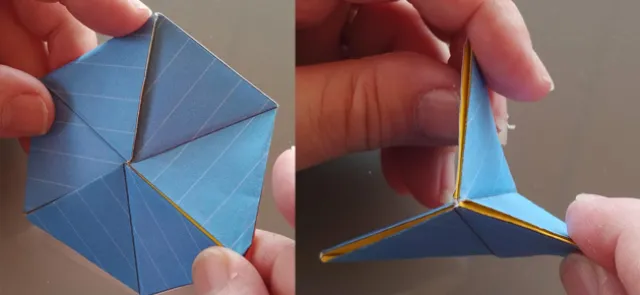
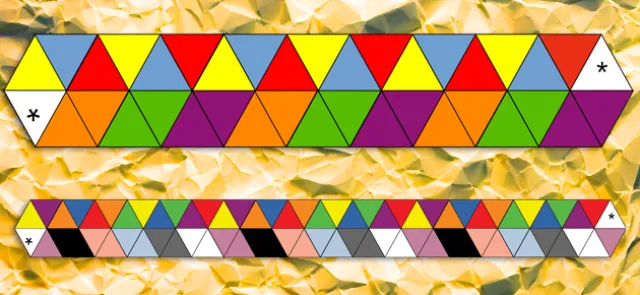
The first hexagonal-faced flexagon studied had three stable positions. Methods were quickly found for constructing an associated hexaflexagon for a given number of stable positions — and even several different hexaflexagons…
 Podcast
Tetraflexagons: squarely strange | Tangente
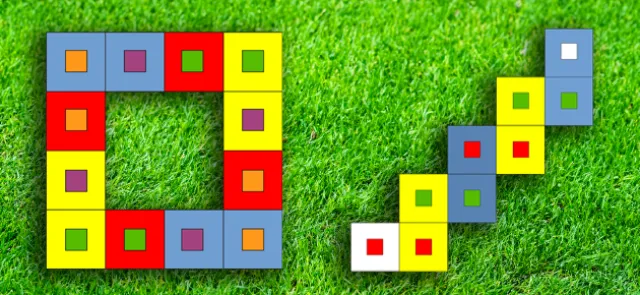
Unlike hexaflexagons, known for their regularity, tetraflexagons, whose faces are squares, have always escaped systematic study. They exhibit several types of cycles, and the complexity of handling them contrasts sharply with the apparent simplicity of their shape.
 Podcast
Flexible in three dimensions | Tangente
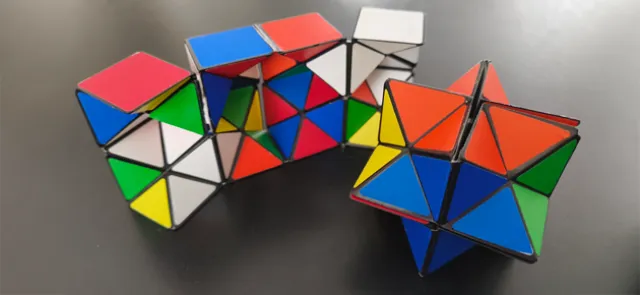
The flexacube and a more sophisticated form, the Yoshimoto cube, are three-dimensional versions of flexagons. Beyond their construction, these astonishing objects raise questions about the flexibility of polyhedra and formalize that question: under what condition does a solid remain rigid?