Let's open a game box: chances are good (pun intended!) that this box contains dice — dice, meaning an element of chance that will affect how the game unfolds. Yet this element of chance differs from game to game: it may be the very foundation of the mechanics, or just a minor twist, meant simply to spice up the game and bring about reversals of fortune. With chance, anything is possible! A brief tour of chance in games…
Let's begin with games of pure chance: there are, of course, lotto games, well known to clubs and children alike; no action is required from players beyond placing a token on the squares whose numbers come up as the draw proceeds. In fact, players don't even need to be present: the host can watch alone to see who wins. This is indeed the case with the Loto national organized by the Française des jeux. Among these games of pure chance there is also the very old échelles et serpent, or the jeu de l'oie, where progress is determined solely by the results of dice rolls, without any player intervention. The appeal of these games lies in placing oneself entirely in the hands of chance. We win, we lose, but it's never our fault: it's the fate of that particular game.
Party games: chance above all
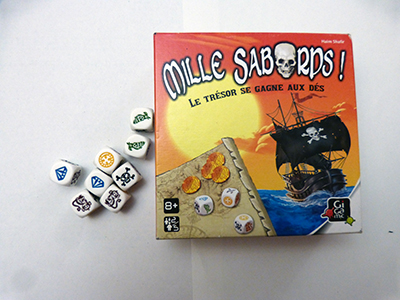
Not all dice games are like this. Faced with a situation determined by chance, a player may have to make a decision. This is the case, for example, with games that let you reroll (or not) the dice to try to get a more favorable outcome. You can certainly go with your gut, but a little knowledge of probability is generally not wasted. Among these games, the classics 421 and Yam's require weighing whether to keep an average result or keep rolling the dice at the risk of losing everything. The same goes for games such as Mille sabords ! (created by Haim Shafir), which reworks Yahtzee! and can be played by calculating, at each turn, the expected gain from rerolling a given die. In England, the game Pass the Pig (or Jeu de cochons) does the same with little pigs instead of dice — pigs that can land on their feet, on their back, on their snout… to score a certain number of points: you can reroll the pigs to win more points, but you'll lose all your accumulated points if they land on their side. In Germany, the game Qwixx (created by Steffen Benndorf) also uses dice combinations to check off numbers from 2 to 12 as the game proceeds. While the luck of the roll plays a key role, choosing which box to check off first also calls for keeping in mind how often the various combinations turn up: there's no point rushing to check off a 7, which should come up fairly often — certainly more often than a 12…