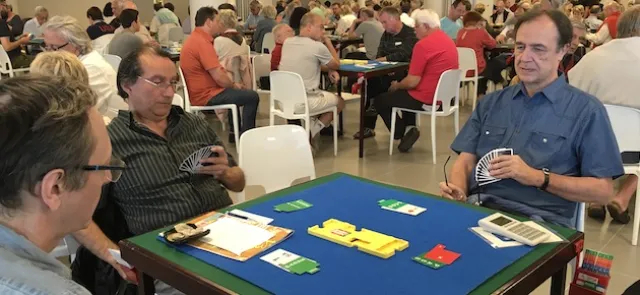
Bridge is played two against two, around a table, with both phases (bidding and card play) proceeding clockwise (the players are designated by the four cardinal points South, West, North and East). The bidding phase, once ended by three successive "Pass" calls, leads one of the two sides to commit to making a certain number of tricks, choosing a trump suit or "no trump." One of the players on the opposing side (the defense or the defenders) leads a card and the dummy lays down their hand while their partner, the declarer, tries to make the contract.
A game of incomplete information
-----------------------------------
Empirical statistics, based on the a priori conditions for success of a given contract, play an important role in the bidding phase. In card play, by contrast, it is probability theory that comes into play. Its first characteristic, incomplete information, poses no difficulty for the theory, which has studied the subject in depth. Imperfect memory, however (at a given point in the game, East knows only imperfectly what West holds, and vice versa), makes the analysis trickier and leads to certain paradoxes.
Reinhard Selten, who shared the Nobel Prize in Economics with John Nash and John Harsanyi, in fact breaks with this approach. He proposes treating each of the four players in isolation — in practice there are only three left after the opening lead, since the fourth is the "dummy" — and taking their partnership into account only through the existence of shared objectives, namely bidding and then making the contract, or going down.
Another feature that makes the analysis tricky is the large number of decisions made in the course of a single hand: on each trick, the player who won the previous trick must decide which card to lead, and each of the other players which card to play. Admittedly, the choice is limited by the obligation to "follow suit," but the total number of possibilities remains staggering.