While it is not possible to explore every realm where go and mathematics meet, this article will attempt to give an elementary but representative overview, venture up to a few summits, and then invite the reader to travel further in each direction.
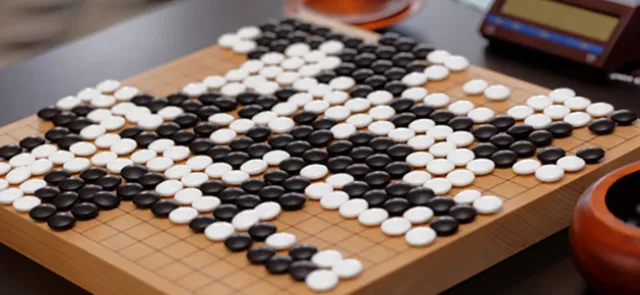
Go is a Chinese strategy game that was already widespread before our era. Its place within the Chinese intellectual elite made it a highly regarded game, establishing it as one of the four accomplishments of a cultivated society, alongside music, calligraphy and painting. It is played on a grid board called a goban, whose most common size is 19×19 (counting the number of intersection points). The goban, empty at the start of the game, becomes the battleground where the two opponents — Black and White — compete to conquer the largest territory (see box).
Insights from combinatorics
----------------------------------
The game of go is inherently finite: a goban has only 361 intersections, so there are only finitely many possible moves and games. Naturally, combinatorics is the first field to tackle this game.