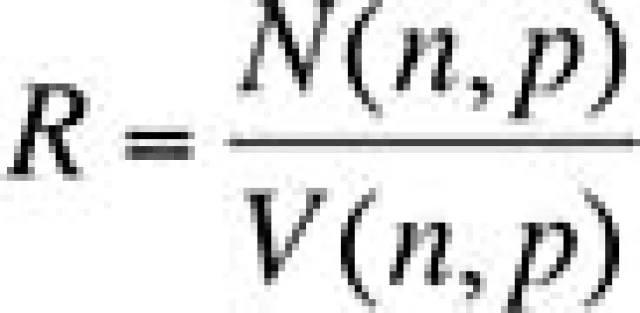
In many games, the gap between two players shows up as a difference in accumulated score. But in many others, the winner is not determined by a score but by a condition at the end of the game. This is the case for two-player games in which you win once your opponent can no longer play. The lead can then be measured by the number of moves that would still be available before all moves run out.
The game Domineering will be our running example throughout. It is played on a rectangular grid. Two players, Henri and Valentine, take turns placing a domino on the grid, with no overlapping allowed. Henri places his dominoes horizontally and Valentine, vertically. The first player unable to place a domino loses.
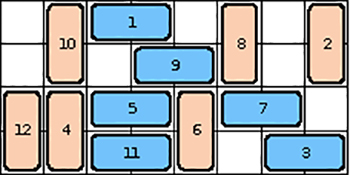
In the example above, Henri went first. On the 8 × 4 grid he placed the blue dominoes, each bearing the (odd) number of its turn, from 1 to 11. Valentine placed the orange dominoes (even, numbered from 2 to 12). After turn 12, Henri loses the game, since he can no longer place a domino.
The theoretical framework of combinatorial games
---------------------------------------------