In the 18th century, the Hungarian polymath Farkas Kempelen designed a chess-playing automaton that enjoyed tremendous success throughout Europe. It was, admittedly, a hoax—one not exposed until 1834—but it suggested for the first time the idea of using a game to test artificial intelligence.
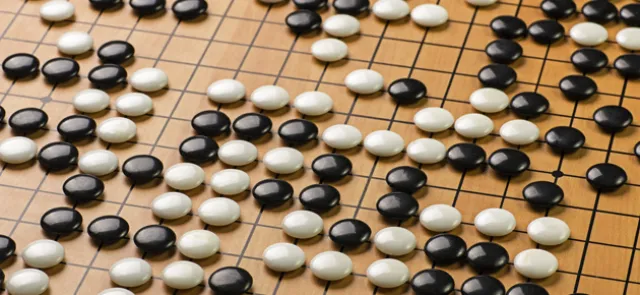
Since Kempelen's hoax, chess has been the most extensively studied game of pure strategy. After losing in 1996, the computer Deep Blue—named in reference to IBM, nicknamed Big Blue—defeated the reigning world champion, Garry Kasparov, in 1997. AI developers then turned their attention to a more complex game: go. The number of possible positions in go is estimated to be on the order of 10172, compared with "only" 1043 in chess.
-
A game of territory
---------------------
In a game of this kind, two levels of analysis seem to be required: the local, or tactical, and the global, or strategic. In chess, taking stock of the pieces and analyzing their positions is enough to get an idea of who is ahead; in a game of territories such as go, matters are different. To determine who is ahead, and by how much, one must be able to estimate the game's likely outcome. This leads to a paradox: to know how to continue the game, one must know how to finish it!
The performance of Go algorithms was greatly improved in 2006 through the use of the so-called Monte Carlo method, which allows the vast tree of possible moves to be studied statistically. DeepMind, founded in 2010 and acquired by Google in 2014, aims to formalize intelligence by combining the best techniques from machine learning and neuroscience to "understand some of the mysteries of our minds".