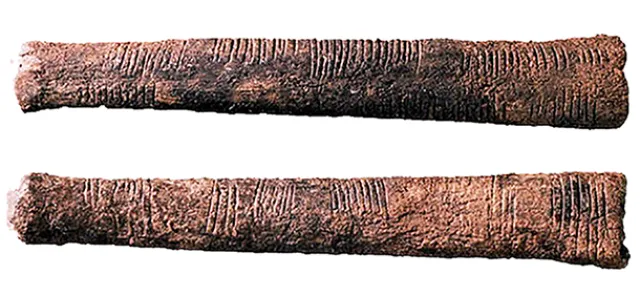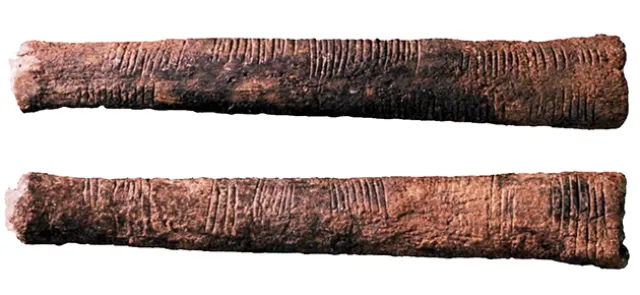

At the Natural Sciences Museum in Brussels is a bone scored with numerous notches, discovered in the 1950s at Ishango in the Belgian Congo (now the Democratic Republic of the Congo) by the geologist Jean de Heinzelin de Braucourt (1920–1998). This bone, dated to 20,000 BCE, is not the oldest known artifact of its kind, but the number of its notches has given rise to a great many hypotheses.
If you know where to look, you will find the number 60 (which, since the time of the Mesopotamians, has been linked to astronomy) and prime numbers such as 11, 13, 17 and 19. Some have concluded from this that it was a lunar calendar, since 60 almost matches the number of days in two lunar months. Because the sum of the numbers in two of its columns sometimes turns up again elsewhere, others see it as an ancestor of the calculator. Another hypothesis put forward is that it was a mathematical game that Ishango man might have played.
The multiplicity of hypotheses shows that their common origin lies in probability theory: the more numbers you consider, the more relations you can find among them. And what if the Ishango bone had been intended only for counting — perhaps a counting game? That would prove that Ishango man knew how to count…