From intuition to rigor
In Euclid’s geometry, a line already divided the plane into two distinct regions, but negative lengths were not accepted. How can the algebraic notions of direction and measurement be brought into geometry?


In Euclid’s geometry, a line already divided the plane into two distinct regions, but negative lengths were not accepted. How can the algebraic notions of direction and measurement be brought into geometry?


Articles recommended for you.

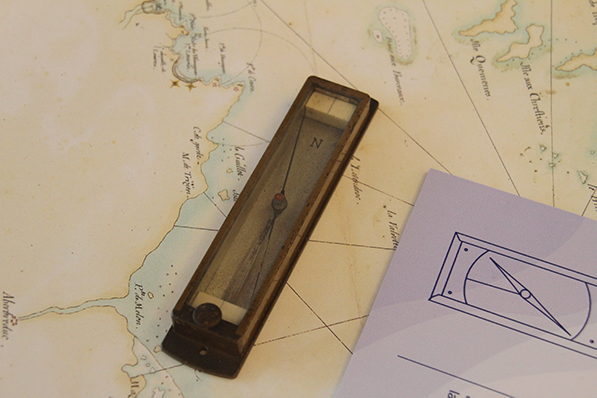
We encounter broken symmetries every day, allowing us to distinguish up from down and right from left. Likewise, when objects in our mathematical spaces can be oriented, their orientation inevitably rests on an arbitrary definition.

The Greek mathematician, geographer and astronomer Claudius Ptolemy discovered a theorem about quadrilaterals inscribed in a circle in the second century CE. His result is certainly far less famous than that of his compatriot Pythagoras, but it is every bit as beautiful.

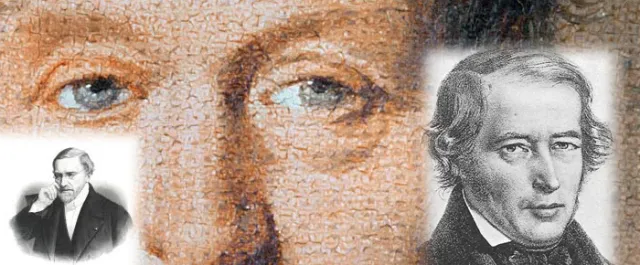
The midpoint of two points and the center of gravity of a triangle are familiar concepts from middle school onward. What do they have in common? How can they be generalized? In the early 19th century, a new approach to geometry put them on a firm mathematical footing through the concept of the barycenter.

In physics, forces and velocities are usually represented by vectors, mathematical objects with both magnitude and direction. Yet their behavior under a change of frame reveals two types of vectors, depending on the orientation of space: polar and axial.
Discussion
Sign in to post a comment and talk with other readers.
No comments yet. Be the first to respond.