



Orientation
The notion of orientation makes it possible to greatly enhance the power and applications of geometry. How to find one's way on a line, on a plane, in space? Why are some objects, like the famous Möbius strip, said to be "non-orientable"? Why do clock hands turn in one direction and not the other? Not all orientation choices are arbitrary and, as is often the case in the history of science, it took several decades to move from intuition to rigor on these questions. If you feel a bit lost, you should find your way through the following pages…
All articles in this folder

The etymology and history of orientation | Tangente
Do you know where the words "orientation" and "orient" come from?

The Möbius strip in art | Tangente
The legendary Möbius strip—a two-dimensional, non-orientable surface with only one side, easily made from a strip of paper—has inspired several artists.

Why do clocks turn clockwise? | Tangente
Clock hands turn clockwise, rather than counterclockwise. Why?
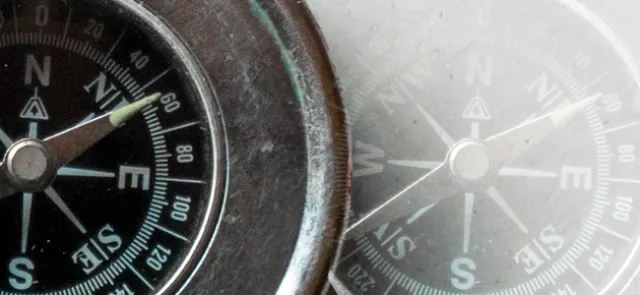
From intuition to rigor
In Euclid’s geometry, a line already divided the plane into two distinct regions, but negative lengths were not accepted. How can the algebraic notions of direction and measurement be brought into geometry?
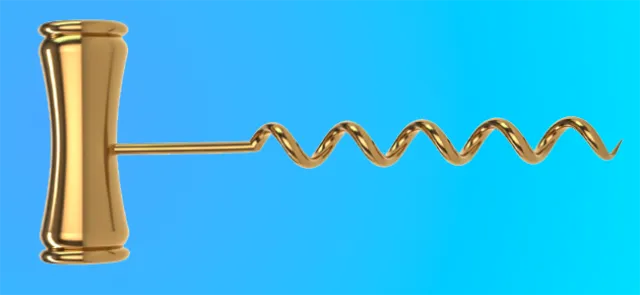
Mathematics points the way
We encounter broken symmetries every day, allowing us to distinguish up from down and right from left. Likewise, when objects in our mathematical spaces can be oriented, their orientation inevitably rests on an arbitrary definition.
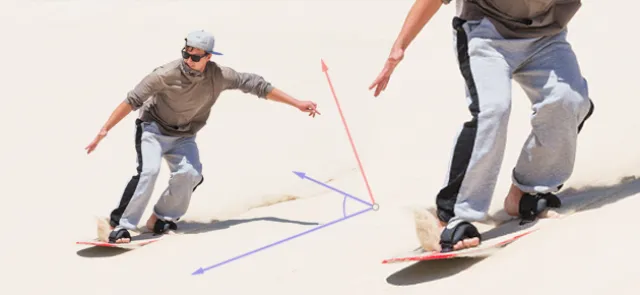
Polar vectors and axial vectors
In physics, forces and velocities are usually represented by vectors, mathematical objects with both magnitude and direction. Yet their behavior under a change of frame reveals two types of vectors, depending on the orientation of space: polar and axial.