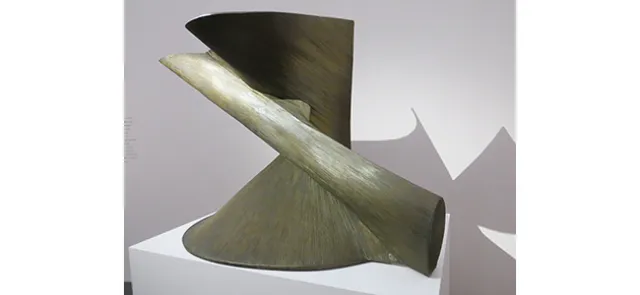
Digital sculptures are 3D objects found throughout society, from the automotive and aerospace industries to medicine. Here, we are particularly interested in their use in digital art. Although these digital fabrication techniques are now beginning to develop on an industrial scale, they were initially confined to the little-known world of laboratories and small workshops. How did the need to use "additive manufacturing" for sculpture arise?
Subtractive manufacturing, additive manufacturing
----------------------------------------------
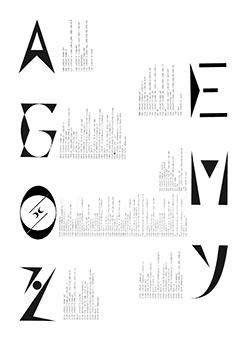
Christian Lavigne is known as a multimedia artist. After studying science, he described himself as a poet and devoted himself to visual art. He began in 2D, producing abstract drawings inspired by reflections on the notion of writing, which is linked to drawing and poetry in Asian cultures. In 1984, he devised the concept of "graphènes," a kind of abstract typographic figure reminiscent of Vassily Kandinsky's "vocabulary of forms." As he put it: "My visual creations always have a poetic meaning and a mathematical form." He then sought a practical tool that would allow him to give physical form to his creations and bring art, poetry and mathematics together. His first digital work was Graphènes 1, created in 2D. Soon afterward, he became one of France's pioneers of digital sculpture. In 1988, he coined the term "robosculpture" to describe the creative process extending from computer-based calculations to the work's physical production in 3D. In 1992, he co-founded the Ars Mathematica association with Alexandre Vitkine (1910–2014). Then, in 1993, he organized the world's first digital sculpture exhibition, which would become the Intersculpt biennial. He is currently working on a book entitled Cybersculpture – Mythologie et histoire de la sculpture et de ses machines, which will shed light on the origins of the discipline.