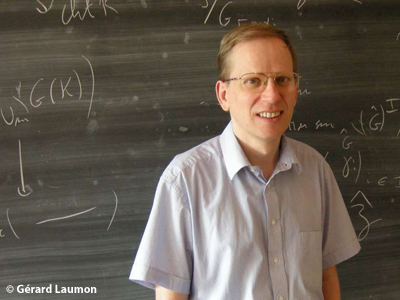
A research director at the CNRS, he began his career by making decisive contributions to the Baum–Connes conjecture in the theory of operator algebras. He then turned to the Langlands program (see *Tangente* 149), a field in which his brother had distinguished himself. He went further still, using a highly general ("many-legged") version of the shtukas introduced by Vladimir Drinfeld in the 1970s to tackle the Langlands program dynamically: in a sweeping two-hundred-page paper written in French, he found a "wonderfully simple and direct argument" that finally explains why the correspondence conjectured by Langlands "is not a miraculous consequence of complicated calculations" and why "it has to be true", according to Richard Taylor, who helped prove Fermat's Last Theorem with Andrew Wiles in 1995.
Now at the Institut Joseph-Fourier in Grenoble, Vincent Lafforgue is deeply concerned about the current ecological crisis and has turned his attention to the role of operator algebras in quantum mechanics, in the hope of helping to envision new materials that could lead to clean energy.