"P = NP? Easy equation: N = 1," a high-school student might say. "You forgot P = 0," her more rigorous classmate might add. The reality is a little more complicated. Before exploring its precise meaning, let's try to grasp the idea through an example.
Solving a puzzle
------------------
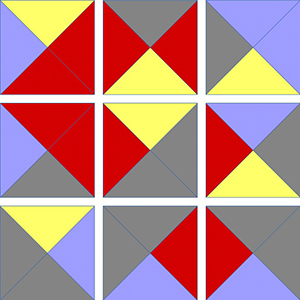
In 2007, the Japanese game company Takara Tomy Co. released a puzzle consisting of 256 square pieces, to be placed in a 16 × 16 square. Each side of a piece has a color, indicated by the triangle resting on that side (as in the example below, with nine pieces in the figure on the left). The puzzle must be filled subject to a single constraint: two pieces can be placed side by side only if their touching sides are the same color (the completed puzzle is shown in the figure on the right).