To understand and model natural phenomena, whether physical or biological, we use a particular class of mathematical equations: partial differential equations (PDEs), which extend ordinary differential equations *see [our feature in this issue] to cases where the unknown function has several variables. PDEs are used, for example, to model vortices in air or water, heat transfer, electrostatic phenomena, the spread of a virus and general relativity see* [Tangente* 198, 2021, and [Tangente 203, 2022]*](https://www.tangentemag.com/numero.php?id=208)… Such equations arise everywhere, yet unfortunately we do not know how to solve the vast majority of them "exactly."
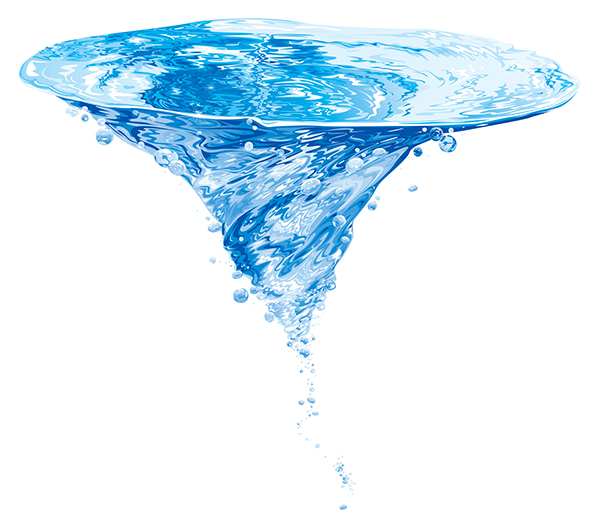
Water vortex.
Worse still, for some of these equations we cannot even prove mathematically whether solutions exist. This is true of the three-dimensional Navier–Stokes equations, which describe vortices in fluids (water, air…). Physically, we can "plainly see" vortices forming (so solutions do exist!), but we do not know how to prove this rigorously. Solving these equations rigorously is one of the Millennium Prize Problems (a prize of one million dollars will be awarded to anyone who succeeds in proving mathematically that such solutions exist).