



Bézout's theorem
In its arithmetic version, Bézout's theorem is a true invitation to the discovery of "pleasing and delectable" problems, that Bachet de Meziriac had devised and that Tangente continues to offer you. Many elementary arithmetic results follow from it, and will allow you to exercise your sagacity. Bézout's theorem also comes in a polynomial version. This time, it has applications extending into integral calculus and plays a particular role in studying the intersection of algebraic curves.
All articles in this folder
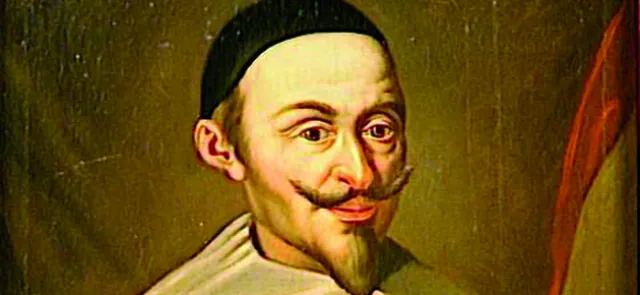
A happy identity
The famous Bézout theorem—actually proved earlier by Bachet de Méziriac—may look simple, but it opens up many avenues in both arithmetic and algebra. This discovery makes it easier to solve a great many Diophantine equations, among other things...
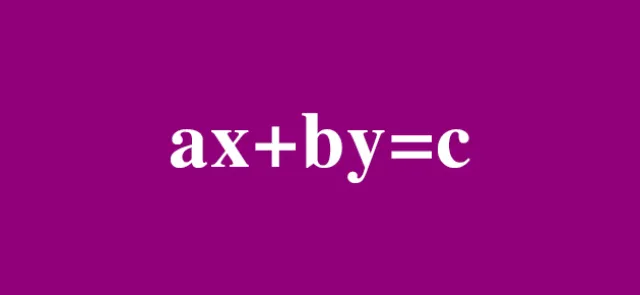
Bachet and Bézout: a winning mathematical duo
From Gauss's lemma to the Chinese remainder theorem, by way of numerous Diophantine equations, no problem seems able to resist the Bachet–Bézout theorem. Games, recreational puzzles, arithmetical tricks… Let's dive into mathematics!
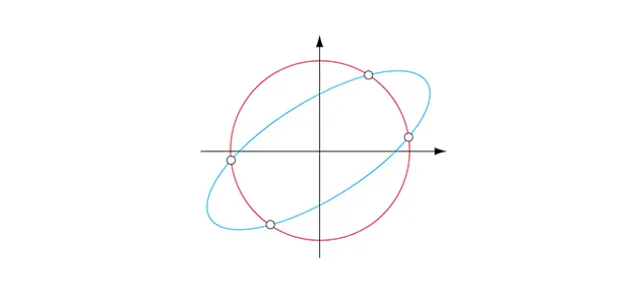
From Bézout's theorem for polynomials to the intersection of conics
Étienne Bézout is known for two theorems. One generalizes Bachet's theorem from integers to polynomials; the other concerns the intersection points of algebraic curves. The two are in fact related, but in a subtle way.