



Curious p-adic numbers
At the turn of the 20th century, the algebraist Kurt Hensel had the brilliant intuition that led to the invention of p-adic numbers. The system thus obtained is enough to bewilder: no more need for a 'minus' sign, necessity to develop a new form of proximity between numbers, appearance of an astonishing topology, and above all… profound applications in all areas of mathematics! The very writing of these numbers, different depending on the approaches (they can even be written with 'decimals to the left'), is surprising. Thus, a negative number like –1 is represented with an infinite number of digits or as the sum of a series that one might think diverges. A true poetry of numbers!
All articles in this folder
10-adic numbers
Some mathematicians, tired of manipulating objects according to established procedures, begin to play with the rules themselves. What seems to be nothing more than pure intellectual pleasure often finds unexpected applications. Such is the case with 10-adic numbers...

A dive into a strange world of numbers
At the beginning of the 20th century, the German mathematician Kurt Hensel "invented" new numbers, written with infinitely many digits, as in the decimal system, but based on a very different notion of proximity. This curious theory proved very fruitful in arithmetic!
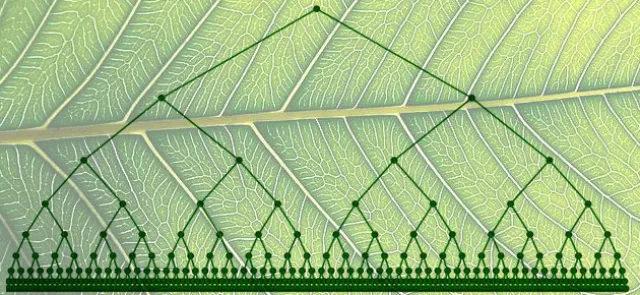
The dyadic tree
An infinite tree can be used to construct either the positive integers or the dyadic integers. The trick is to choose carefully where to put the 0s and 1s.

Kurt Hensel, the father of p-adic numbers
Kurt Hensel is best known for his research on p-adic numbers.