



Magazine
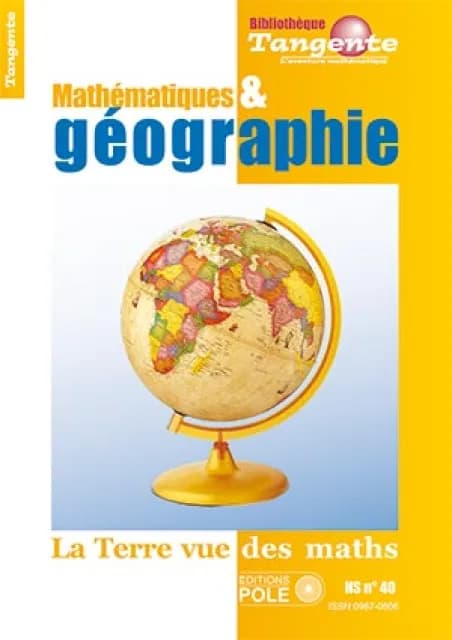
Maths & Geography
December 1, 2010
- Number
- 40
- Published
- December 1, 2010
- Pages
- 168
- ISBN
- 9782848841175
- Price
- €22.00
About this book
CONTENTS
The shape of the Earth history / The IGN / Gauss and cartography / Distances / Exotic mathematics / GPS
Feature 1: Physical Geography
At a time when climate models are a major issue, it is useful to recall that mathematics plays an important role in explaining certain natural phenomena such as tides, wind, and ocean currents.
The length of rivers / Tides, a complex and fascinating phenomenon / The new geography / The Samos enigma / Wind and ocean currents
Feature 2: Cartography
The art of cartography mobilizes very varied techniques and scientific knowledge. The cartographer must be capable of projecting the representation of the globe's surface onto a flat surface while preserving certain geometric constraints (length, angles, or distances).
The evolution of measurements / Geometrizing the Earth / The hiker's path / From projections to the map / France from the train / Building a terrestrial globe / Wavelets, a tool from the ground up
Feature 3: Topography
Man travels the world, conquers, builds and questions. He wants to measure and describe the land he inhabits. Topography, cartography and geodesy are linked to geometry and combine to access knowledge. Instruments evolve, but the questions remain the same: appreciating a length, measuring an area, evaluating a relief...
Journey in Topography / This is not a sphere / Measuring the Earth, what an idea! / Surveyor's instruments / Measuring linear by angular / Triangulation / Representing relief / How to orient towards Mecca? / Finding one's position at sea
Feature 4: Human Geography
The political, demographic, economic, social, and societal stakes of human geography are colossal. We measure this by the pension debate that spares no country in the world. Among the essential figures used in all models are demographic data. Life expectancy / Statistics in France / Women die half as often as men! / The census / Around Verhulst's equation / From population dynamics to chaos theory / Zipf's law and the size of cities / Not everyone will be called Martin! / Aboriginals, a mathematical culture / Mean field theory
And always
Problems - solutions - in brief - reading notes