♦♦♦ Anti-associativité

This article is not yet available in English; the French version is shown.

Articles recommended for you.

A simple, classic, real-world application of the mathematical concept of a group can be found in social anthropology. It was brought to light by the anthropologist and ethnologist Claude Lévi-Strauss, working with the mathematician André Weil.

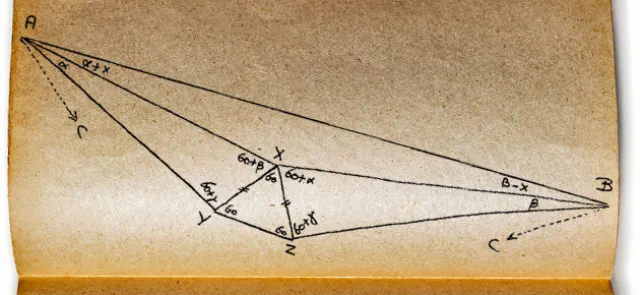
A symmetry appearing out of nowhere, an equilateral triangle emerging amid the trisectors of a completely arbitrary triangle: that is the whole "miracle" of Morley and his theorem. The many proofs of this beautiful property are marvels of geometry and trigonometry.

The concept of a group emerged in the early 19th century to solve polynomial equations and very quickly spread to other fields, including those outside mathematics: it allows us to focus on relationships between objects rather than on the objects themselves.

In this bicentenary year of 2021, let's revisit a result that bears his name. The emperor is said to have had a keen interest in geometry; according to one story, he once discussed the subject with two mathematicians of his day, Joseph Lagrange (1763–1813) and Pierre-Simon Laplace (1749–1827).