Accidents: coexisting with machines
------------------------------------
Do machines drive less well than humans? There is still too little evidence to say for sure. However, automation cannot be blamed for any of the confirmed accidents involving autonomous vehicles. The first accident involving a Google Car, in February 2016, was attributable to the driver. The car, stopped behind some sandbags, had to change lanes. After seeing a bus in the rear-view mirror, the driver gambled that it would slow down or stop, then forced their way into the lane.
In March 2018, an Uber taxi struck and killed a woman. The preliminary report by the US transport regulator points to human factors and urges caution in analysing the incident. The victim was crossing the road at night along an unlit stretch, was dressed in black and was pushing a bicycle without reflectors. Her toxicology tests also came back positive. Most importantly, the car's emergency braking system was not enabled. The driver, who was supposed to take control if anything went wrong, was looking at her smartphone…
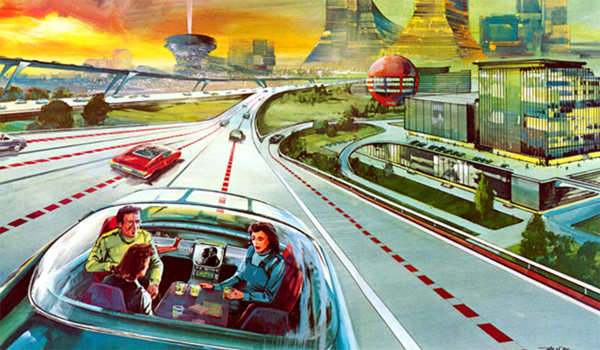
Günter Radtke’s World of Tomorrow (1960).
-
The trolley problem
-------------------
British-American philosopher Philippa Ruth Foot became famous in 1967 for her trolley problem. An out-of-control trolley is heading towards a group of five people. You can stop it with something heavy. By "good fortune," an enormous person happens to walk past. You have a choice: sacrifice that person and save the other five, or do nothing and let the five people die.
Researchers at MIT, the University of Oregon and the École d’économie de Toulouse have sought an answer to this problem as it applies to autonomous cars. The team developed a simulator called Moral Machine. Tens of millions of scenarios have already been judged by internet users from around a hundred countries. Readers can contribute to the tests via the following website: moralmachine.mit.edu/hl/fr.
-
Determining responsibility mathematically
------------------------------------------
Naturally, no one would consider buying a car that might sacrifice them. Israeli automotive supplier Mobileye, now a subsidiary of Intel, has offered carmakers a solution: a mathematical model of responsibility in accidents. The aim would be to separate programming from regulatory considerations.
Comfort driving, based on machine-learning techniques, would be separated from safety-related decisions, which would be based on a predefined model. Once the relevant government authorities had approved this model, manufacturers would merely need to have their vehicles certified. Mobileye published a scientific paper that the US National Highway Traffic Safety Administration (NHTSA) scrutinised: after testing thirty-seven pre-crash scenarios, it found no errors.
-
Ethical algorithms
------------------
Article 121-1 of the French Criminal Code is clear: the driver of a vehicle is responsible for offences that they commit while driving that vehicle, not the manufacturer, its equipment supplier, the software programmer or the author of its algorithm. In future, liability will depend on the various parties able to control an autonomous vehicle and on the extent to which each can intervene or make corrections.
The onboard software can always be updated—for example, to teach it to be "wary" of buses. This is a process of continuous improvement that addresses every newly identified gap.
Manufacturers and researchers at the University of Bologna in Italy have even envisaged an "ethics button" that would alter the decision path in the onboard software when a crash is unavoidable and fatal. The idea is to let drivers assume responsibility: they can either choose to "save their own life," thereby acting selfishly, or to "save others," thereby acting altruistically. Allowing them to choose has another advantage: they can change their approach to the problem according to their personal circumstances. Imagine, for example, a father setting the button to "altruistic" mode when driving to work, but to "selfish" mode when his children are in the back seat.
There is a precedent: because a car's front passenger airbag is highly dangerous to young children, the driver must disable it when necessary.