

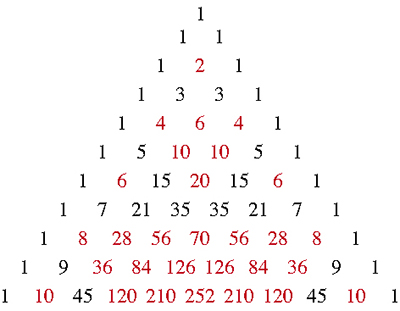
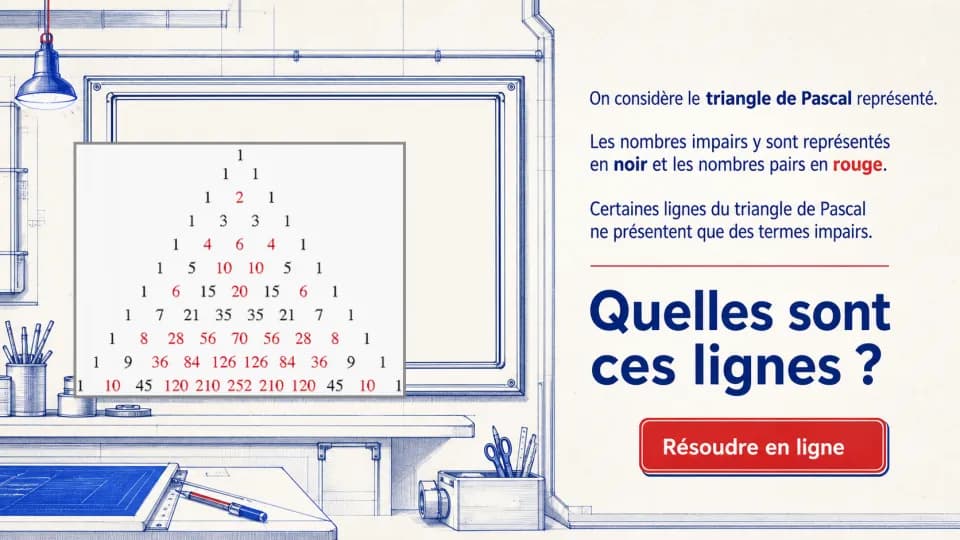
Dans ce triangle de Pascal, on a représenté les nombres impairs en noir et les nombres pairs en rouge. Certaines lignes du triangle de Pascal ne présentent que des termes impairs.
Quelles sont ces lignes ?
This article is not yet available in English; the French version is shown.
Articles recommended for you.

Rich in countless combinatorial and numerical properties, Pascal's triangle is ubiquitous in mathematics. Some of its applications in analysis, however, remain little known. The capabilities of the fx-CP400+E computer algebra calculator suggest a signal-processing activity.
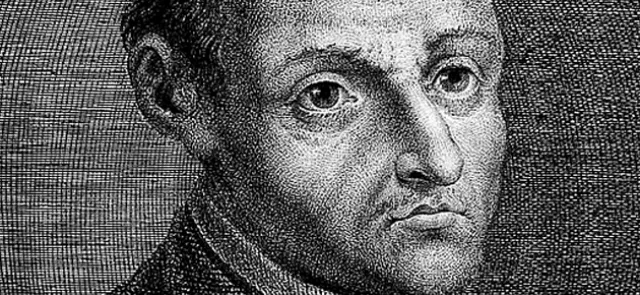
A member of a Greek family that emigrated to Sicily after the fall of Constantinople, Francesco Maurolico was born in Messina in 1494 and died there in 1575. He entered the Church at the age of 27, proposed an extension of figurate numbers, and established many of their arithmetic properties.

"Pascal's triangle" may have been discovered by Indians more than two thousand years ago. It reached the Arab-Muslim world and China as early as the 11th century. It did not appear in Europe until the 16th century, when Blaise Pascal began to study it rigorously.
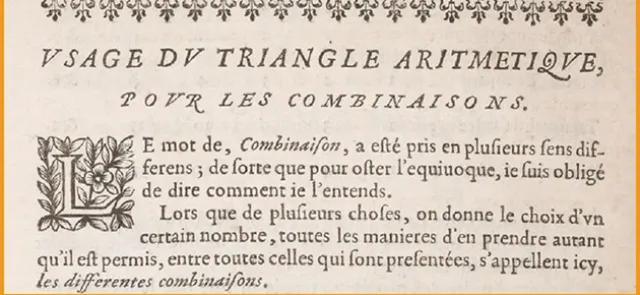
If you know how to fill in Pascal's triangle, you may be less aware of the treasures it contains. Arithmetic, geometric, combinatorial: it has no shortage of astonishing mathematical properties! And there are undoubtedly many more still to be discovered…