Today, many traces remain of enumerations conducted by the earliest empires: in Mesopotamia, Egypt, Rome, ancient India and ancient China…
Each of these civilizations organized the collection of statistics in its own way. What did they need to count? The population, on the one hand, so that they could organize military conscription and forced labor; agricultural and manufactured goods, on the other, so that they could levy taxes. The emergence of the earliest forms of the state is thus inseparable from the need for knowledge about the territories and populations under its administration: statistical knowledge provides a foundation for political power.
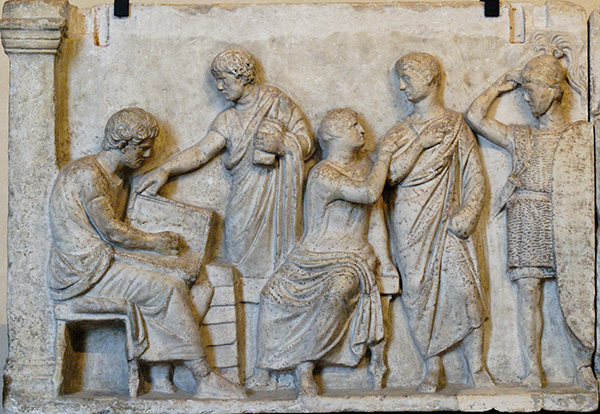
Bas-relief from the Altar of Domitius Ahenobarbus,
showing a census being taken.
Despite differences in administration and numeral systems, these statistical inquiries chiefly took the form of the "census," which aimed for complete coverage. The word comes from Latin: the Romans conducted several census ("assessments") of their citizens. These made it possible both to count all men of military age and to organize civic assemblies according to assessed levels of wealth.