



Digits and…numbers
Just as a word is composed of letters, a number is made up of digits. Our positional decimal system (which uses ten digits, whose position in the writing of the number matters) is a way — quite powerful — to represent a number. But what effects can be obtained by manipulating this sequence of digits? The creativity brought by some in the search for answers to this question opens the door to a new universe. You will discover happy, narcissistic or palindromic numbers, the notions of persistence, some intriguing properties of prime numbers... and many other curiosities.
All articles in this folder
 Podcast
It doesn't take much to be happy
We know that mathematics can be a source of joy, but have you heard of happy numbers? Simple to define, they hold plenty of surprises and show just how much playing with integers remains an inexhaustible source of research at every level.
 Podcast
Palindromic numbers: numerical symmetry | Tangente
These numbers, which can be read equally well from left to right or from right to left, raise questions. At first glance they seem highly unusual, and therefore rare. Yet when an elementary arithmetic process is repeated on any whole number whatsoever, we almost always end up with just such a number. Bizarre, how bizarre!

Narcissistic numbers and their secrets | Tangente
In the 1960s, while teaching at the University of Rochester in New York State, Mike Armstrong became particularly interested in k-digit numbers equal to the sum of the kth powers of their digits.
 Podcast
Prime numbers and changing digits | Tangente
Unlike some composite numbers, it is hard to tell whether a number is prime just by looking at it. So what happens to a prime number if we make a change to its digits — for example, by permuting them or removing some of them? Can it stay prime? Or, on the contrary, does it stop being prime?
 Podcast
Multiplicative persistence of numbers | Tangente
Adding or multiplying together the digits of an integer is an activity a curious child might feel like doing. But they probably have no idea that it is the source of problems still unsolved in 2025!
 Podcast
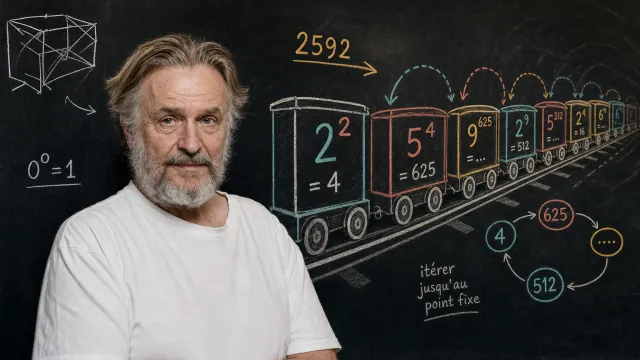
Conway's power trains | Tangente
Power trains are iterated functions introduced by Conway.
 Podcast
Parasitic numbers and permutations | Tangente
How do you multiply 105,263,157,894,736,842 by 2? Simple: just move the final digit, 2, to the front of the number, giving 210,526,315,789,473,684. And there you have it!
 Podcast
Vampire numbers and their fangs | Tangente
Yes, vampire numbers really do exist! And they have fangs!