If you stop high school students as they leave a French class and ask them to name a palindrome word, someone is sure to answer: radar, kayak, or ressasser, or even Laval, explaining to the others that such words can be read from left to right or from right to left. If we are lucky, they will even go so far as to cite the odd-length palindrome sentence "Ésope reste ici et se repose" or the even-length palindrome sentence "Élu par cette crapule". If, by happy chance, we question a literary type well versed in the Oulipo, they will no doubt recall Georges Perec's 1247-word Grand palindrome, beginning with "Trace l'inégal palindrome…" and ending with "…e mord ni la plage ni l'écart". If they happen to be a musician too, they might tell us about the minuet from Haydn's 47th symphony, nicknamed The Palindrome, or about the Crab Canon from Johann Sebastian Bach's Musical Offering, two reverso musical pieces made up of a first part and its retrograde movement. And, as the icing on the cake, if they know their classics, they will be able to give us the etymology of the word palindrome: palin, from the Greek πάλιν, meaning "backward," and drome, from the Greek δρόμος, meaning "course."
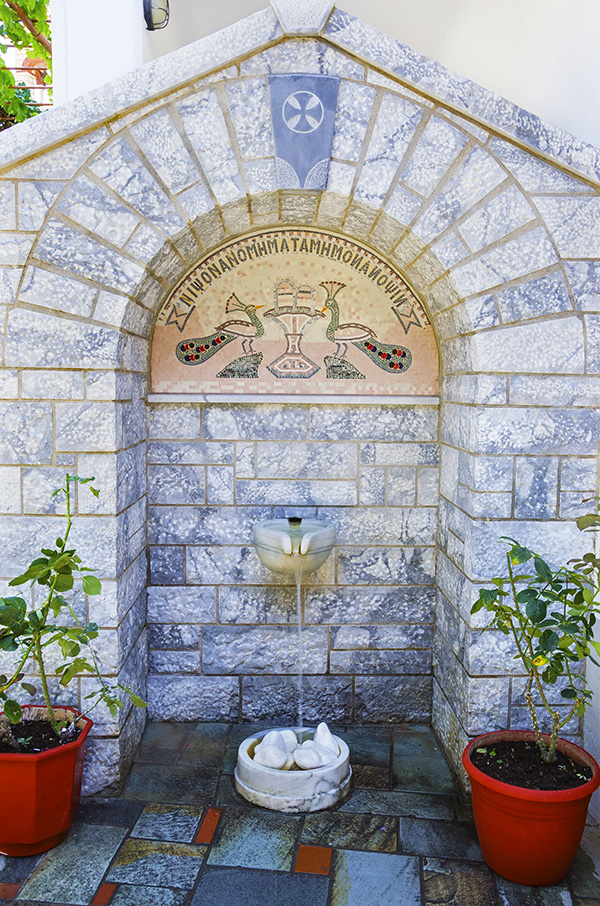
A sink with a Greek palindrome inscription
located in the sacred monastery of Panagia Malevi.