



Diophantine equations
At the crossroads of arithmetic, algebra and analysis lies an illustrious unknown: Diophantus. While nothing is known of his life, the equations bearing his name have given rise to a vast body of literature linking great names such as Pythagoras, Euclid, Fermat, Bézout, Bachet de Mézirac, Lagrange, not forgetting, among so many others, Hypatia and Sophie Germain. This dossier is thus an opportunity to discover the history of Diophantine equations, to show a side of Fermat less well-known than that of his famous "Last Theorem" as well as to marvel at mathematical ingenuity through clever solutions in the form… of billiards!
All articles in this folder
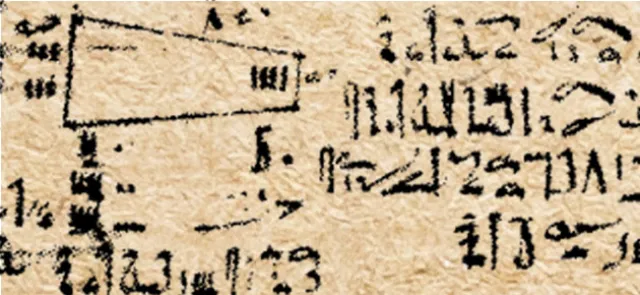
Integers: stars of equations: article by… | Tangente
In ancient Egypt, puzzles and problems were already being framed in terms of equations over the integers. Although the methods used to solve them have changed, the underlying question remains the same. These equations would go on to transform mathematics.
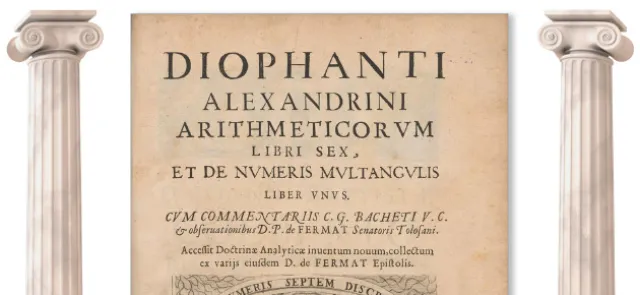
Diophantus of Alexandria, the unknown: article by… | Tangente
As noted on www.diophante.fr, which has just celebrated its 20th anniversary, the Greek mathematician Diophantus left us some remarkable works on arithmetic. A journey into history will reveal his extraordinary talent.
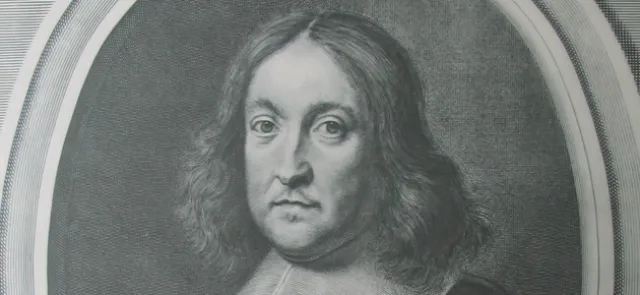
A historical example involving Fermat: article by m… | Tangente
Through his marginal notes in Bachet's edition of Diophantus's books on arithmetic and through his correspondence, the mathematician Pierre de Fermat spurred the study of integers with new results and methods. He both transmitted ideas and drove the subject forward.

Billiards and water-pouring problems
One facet of mathematical creativity is finding an original representation of a problem that makes it easy to solve. Thus, an elementary Diophantine equation can be solved by studying trajectories on a billiard table, turning billiards into an effective tool.