



Euclidean Division
Division, the most difficult of the four elementary operations, has the unpleasant tendency to not always "come out even"; it then admits not only a quotient, but also a remainder: this is Euclidean division. Why does it owe its name to Euclid? It is because with the Greek mathematicians, Euclid in particular, numbers moved from the concrete – with the different algorithms that make it possible to arrive at the result – to the abstract. This approach is indeed the source of many properties, ranging from everyday use (such as the making of calendars) to the most advanced mathematics (such as quadratic residues) via a classic: divisibility criteria.
All articles in this folder

Euclid, master of division
With the Greek mathematicians—Euclid in particular—numbers moved from the concrete to the abstract. One key concept endured: Euclidean division and the host of developments it spawned. These methods have not aged a bit: Euclid's algorithm is still used today... by computer scientists!

The calendar is good for calculations
Our calendar is organized into seven-day weeks. So we sometimes need to calculate remainders modulo 7…

Division algorithms
From the abacus to the counting frame, what a long way we have come to reach our present-day algorithm, so well known to schoolchildren.
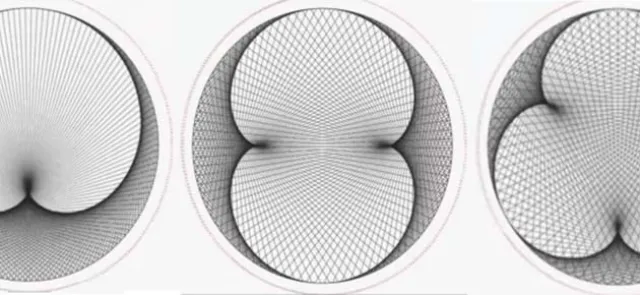
The scant remainder of Euclidean division
When we divide a by n using Euclidean division, we obtain a remainder. This remainder can take only a limited range of values: there are just n of them. This new perspective can simplify many calculations and cast a whole host of problems in a different light!

Divisibility criteria: history and methods | Tangente
You know the divisibility criteria for 2, 3 or 5 — but do you know those for 11 or 25?

GCD algorithms: comparing calculation methods | Tangente
The algorithm for computing the GCD dates back at least to Euclid. It was subsequently refined over the centuries.