Euclid and Euler, neighbours in the dictionary, alphabetically, both left monumental bodies of work. Although their writings are separated by twenty centuries, they shaped the history of mathematics and its teaching for generations. Here we focus on Euclid and his legacy in number theory: in this field, everything—Euclidean division, Euclid's algorithm—bears his name.
The most marvellous textbook of all time
--------------------------------------------
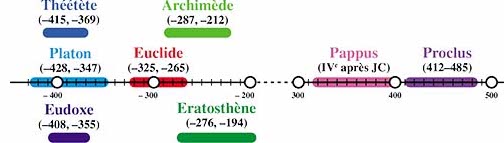
Almost nothing is known about Euclid himself. Some have even doubted that he existed, confusing him with other figures because Euclid was a common name at the time, or suggesting that his work was produced by a group of mathematicians, rather like the Bourbaki group in the 20th century. Eratosthenes nevertheless claimed to be his contemporary, while Archimedes contains references—perhaps added after the event?—to Euclid. Be that as it may, sometime between 325 and 265 BC, someone named Euclid, probably surrounded by a school, assembled a complete body of mathematical knowledge under the title The Elements. It fills thirteen books, which together form the most marvellous mathematics textbook of all time.