To begin with, let us be clear: the word "algorithm" is completely anachronistic in this article! It derives from the name of a well-known 9th-century mathematician, al-Khwârizmî, whereas the algorithm in question is at least ten centuries older. The term does, however, provide a convenient shorthand, sparing us from writing "a sequence of very precise rules to be applied in order to solve a problem," as defined on the Bibm@th website (**www.bibmath.net**).
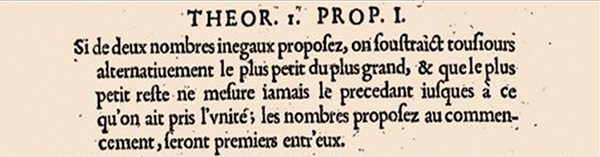
Like the other books of Euclid's Elements, Book VII is rigorously organized: definitions first, then postulates and axioms, and finally propositions and their proofs. Theorem VII.1—the first proposition in Book VII—describes what is probably one of the earliest algorithms in the history of science.
The subtraction algorithm
------------------------------