



Maths and society
The now traditional Maths Week will have the theme in 2021 "Mathematics and society". A vast subject, which led the editorial team to choose a "philosophical" perspective that questions the mathematization of life in society and social interactions. From democratic questions - "Does the aggregate of individual rationalities necessarily lead to the general interest?" - to high-performance computing tools needed to process large volumes of data, including the counting of demonstrators or the use of graphs to model social proximity, the subjects are varied. Another approach to the theme will be covered in issue 56 of Tangente Éducation, under the title: "Mathematical mindset, critical thinking".
All articles in this folder
Diagonal Ramsey numbers
The events committee (BDF) at the École des champions wants to organise a party by inviting people selected at random from the new intake.

Political rationality and calculation | Tangente
Public policies are often supported by rational, even mathematical arguments. Philosophers such as Leibniz, Condorcet and Bentham sought, through a variety of approaches, to put both economic and social behavior on a mathematical footing. Yet they all came up against the fact that combining individual rationalities does not necessarily serve the common good.
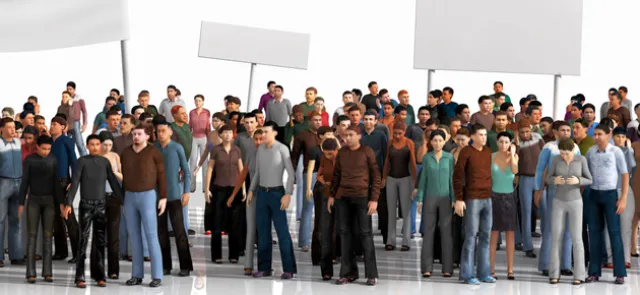
Counting protesters | Tangente
One hundred thousand protesters, according to the organizers; twenty thousand, according to the police! The discrepancy between estimates of the number of people in a march is a perennial source of puzzlement—and mockery—for outside observers. Is there really no way to provide a reliable figure for the number of protesters?

Graphics processors: high-performance computing for everyone?
Numerical simulation is everywhere: from re-entry into the Martian atmosphere and weather forecasting to climate projections, aeronautics, molecular-dynamics calculations, and processing vast volumes of data. High-performance computing has become a matter of public concern.