



Sets, relations and functions: a new approach
A set is a collection of objects – the elements – between which there can exist all kinds of relations. At the elementary level, we can visualize sets using 'potatoids' connected by arrows to represent the relations that link them, but this naive representation quickly reaches its limits, in particular when the sets are infinite. Set theory mainly provides a framework for the rigorous formalization of all areas of mathematics and leads to mind-blowing proofs: more than a simple theory, it is a new approach to mathematics.
All articles in this folder
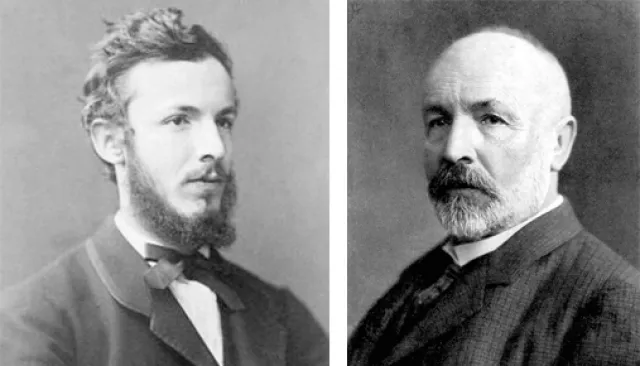
Georg Cantor: from finite to infinite
To extend useful results about finite sets to infinite sets, Cantor defined equality of cardinalities in terms of bijections, and hence inequality in terms of injections and surjections. Remarkably, this yields an order relation.

From a collection of objects to a set
A set can be defined extensionally or intensionally. Constructing the natural numbers then becomes an easy but instructive exercise. Yet beware the apparent simplicity of a set viewed as a mere collection of objects: paradoxes lurk...

The set and its subsets
Elementary operations on sets include inclusion, union, intersection and symmetric difference. The notion of a power set is equally natural and fruitful. How can we describe, count and structure the subsets of a set?
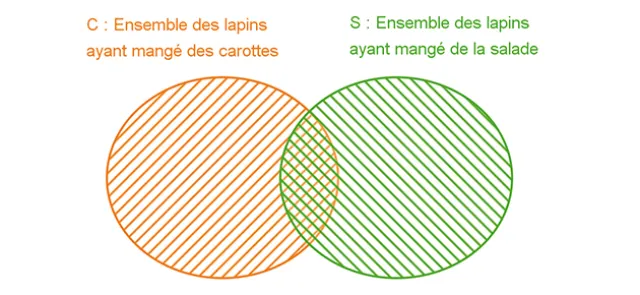
Potato diagrams: a chipper idea
When considering several subsets of the same set, it can be difficult to distinguish their various intersections. Representing these subsets as "potato-shaped blobs" often makes things clearer—and keeps us from looking like potatoes when faced with questions that are simpler than they seem.

The rules of infinity
You cannot play with sets without abiding by certain rules...

Relations and maps: structuring sets
A notion of relation between sets is essential if we are to begin doing mathematics. At the heart of the foundations of mathematics, the concept of a relation includes maps as a special case and gives sets structure.

Naming the elements of a set
As David Hilbert famously remarked, assigning a name to a mathematical object is artificial. Identifying an object with its image under a bijection, however, so as to bring out its properties, can be decisive.

Dazzling binary relations
All people are born free and equal in rights. Yet someone like Coluche could add, not without mischief, that "some are more equal than others"! Defining an order, or an "equality" of some kind, requires us to establish precisely what these notions mean.

Dedekind and sets — Mathematical brief | Tangente
One of the earliest champions of set theory was the German Dedekind, who famously corresponded with Cantor.