Richard Dedekind: an early outline of set theory
----------------------------------------------------------------
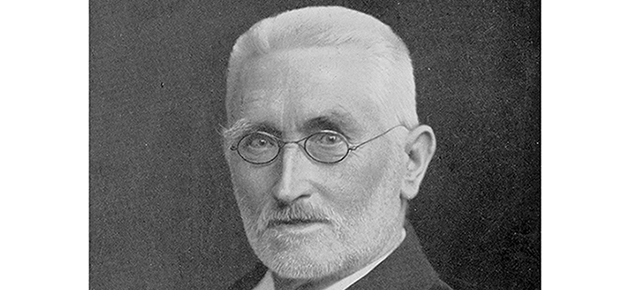
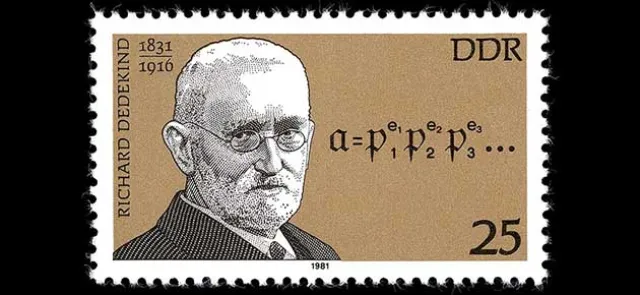
Richard Dedekind's (1831–1916) research in number theory makes extensive use of sets. In the field of algebraic numbers, he introduces the notions of ideal and field, and is the first to teach Galois theory in Germany. Even before Cantor's work, Dedekind freely uses infinite collections, which still raise eyebrows among some of his contemporaries.
Dedekind also uses sets in his foundational work to define the real and natural numbers. In particular, his 1888 definition of the set of natural numbers in Que sont et à quoi servent les nombres ? (What Are Numbers and What Are They For?) relies on a set-theoretic toolkit explicitly developed at the beginning of his memoir. He defines the concept of a set, which he calls a "system": "It very often happens that distinct things a, b, c… are, for whatever reason, viewed from a common standpoint, brought together in thought; we then say that they form a system S." He also gives rigorous definitions of several set-theoretic notions, such as infinite sets and equinumerosity, and proves many important results. The book thus offers an early outline of abstract set theory—even though it is still a long way from ZFC axiomatic set theory.
-
Kronecker's objections
-------------------------
Among the mathematicians who challenge the notion of infinite sets, one of the fiercest is Leopold Kronecker. His vehement opposition to Cantor is well known. In his view, Cantor's theory may be philosophy or theology, but it is certainly not mathematics.
Kronecker also criticized Dedekind's work; the two men were rivals in their research on algebraic numbers. From Kronecker's perspective, set-theoretic methods, being non-constructive and relying on actual infinity, make Dedekind's work overly abstract and difficult to understand and assess.
-
An extensive correspondence with Cantor
------------------------------------
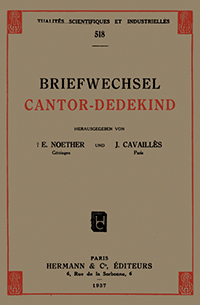
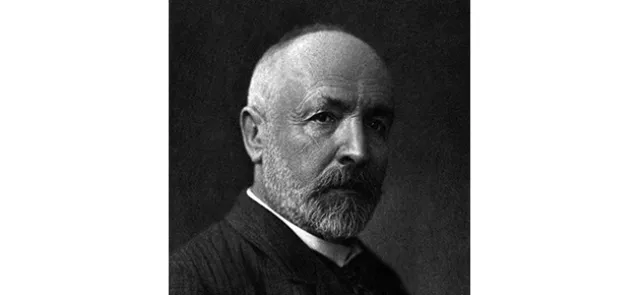
From 1872 onward, Dedekind maintains an extensive but irregular correspondence with Cantor. They mainly discuss Cantor's work; more often than not, Cantor initiates the exchange and seeks his compatriot's opinion. It is precisely Dedekind's approval that Cantor seeks when he discovers that the set of points in a plane region such as a square is the "same size" as the set of points on a line segment. After sending Dedekind his proof, he writes: "Until you have acknowledged that I am right, I can only say: I see it, but I do not believe it."
Dedekind is firmly convinced that infinite sets are useful and acceptable. Even after the publication of Russell's paradoxes, he eventually agrees to a third edition of his book on the natural numbers and writes in the preface that his faith "in the inner harmony of our logic has not been shaken".