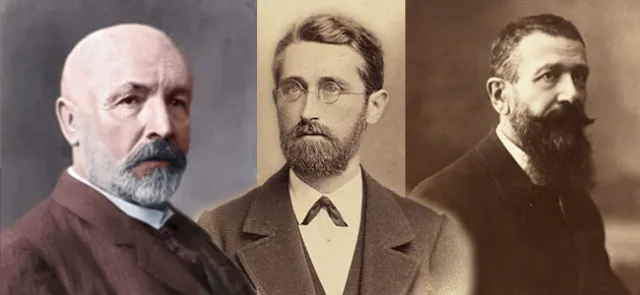
The notion of a set, so familiar to us today, never appeared in mathematics before the work of the German mathematician Georg Cantor. Until then, mathematicians spoke of "manifolds," "totalities" and "classes." Cantor invented not only an entirely new language but also the axiomatic system that went with it, thereby opening Pandora's box on a theory then seen as incongruous, whose later developments and excesses he probably had not foreseen.
-
Cantor: naming concepts
----------------------------
Before the mid-19th century, mathematical concepts took precedence over rigorously stated results. Augustin Cauchy (1789–1857) and Bernard Bolzano (1781–1848) had made tentative efforts to clarify notions such as continuity, limits and convergence in analysis, but it was with the Germans Georg Cantor and Richard Dedekind (1831–1916) that mathematical objects began to be properly named. In 1883, Acta Mathematica published a French version of the papers Cantor had been publishing since 1870, the first outline of his Mengenlehre, which became our "set theory." Deeply concerned with counting problems, particularly how to "count" infinity, Cantor framed the problem of identifying two functions f and g, both represented by trigonometric series developed by Joseph Fourier some fifty years earlier, as follows: what happens if f(x) = g(x) everywhere except on an "exceptional" set? It was then that Cantor laid the foundations of "his" set theory in around a hundred pages.
It was Cantor who defined a set as "a collection M of definite and distinct objects of our conception, which we shall call the elements of M", already using uppercase letters for sets and lowercase letters for their elements. It was also Cantor who, in the six papers he published between 1878 and 1884, codified terms such as equinumerosity, cardinality, the power of a set, nested sets and well-ordered set (the last of which would later lead to the well-ordering theorem). He also defined derived sets (the set of accumulation points of a set) and, along the way, created sets that could be derived infinitely many times, developing a genuine "arithmetic of infinity."