Thinkers in antiquity knew that there were more integers than any given number, but refused to consider all such numbers as a whole. Only a few major precursors, including Galileo, Leibniz, Bolzano, Riemann and Dedekind, gradually brought about acceptance of actual infinity (which became an object in its own right rather than a vague, indefinite notion). Richard Dedekind (1831-1916) was the first to propose a definition of infinity: a set X is infinite if there is a bijection (which he called a one-to-one correspondence) between X and a proper subset of itself. For example, the successor map from ℕ to ℕ \\ {0}, which sends n to n + 1, is a bijection: every element of ℕ has a unique successor in ℕ \\ {0}, and every element of ℕ \\ {0} has a unique predecessor in ℕ.
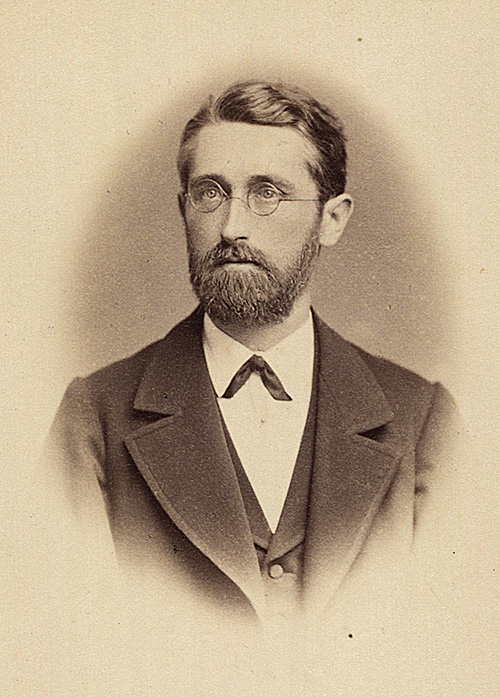
Richard Dedekind, circa 1886.
Paradoxes and the crisis of foundations
----------------------------------------
Starting in the 1870s, Georg Cantor (1845-1918) took a close interest in infinity. In 1873, he proved that the sets ℤ and ℚ are countable, in the sense that they can be put in bijection with ℕ; ℝ, however, is not countable: in a certain sense, there are strictly more real numbers than integers.