Geometry was the first field of mathematics to be axiomatized: this was the great project of Euclid's Elements. Yet the so-called parallel axiom (see "L'origine de la rationnalité") poses a problem. Developed in the 19th century, non-Euclidean geometries revealed that it cannot be deduced from the other axioms. A fine illustration of this is given by Henri Poincaré (1854–1912) with the half-plane that bears his name, which represents hyperbolic geometry within the Euclidean plane: we work in the complex half-plane with strictly positive imaginary part and equip it with a rather unusual metric possessing a certain curvature. The "lines" of this half-plane then turn out to be vertical half-lines and half-circles (in the Euclidean sense). This makes it possible to draw infinitely many parallels to a single "line", thereby violating the parallel axiom.
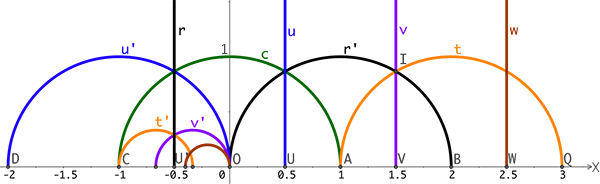
The Poincaré half-plane.
It was in this context — one particularly inclined toward axiomatization — that revisiting the structure Euclid had given geometry came to seem necessary.
Simplicity, independence and articulation
----------------------------------------