Mathematics differs from the other sciences in that it alone provides proofs of certain properties. The advantage of deductive reasoning is that it is reliable, indisputable and immune to controversy, even if this last point may take time to become established (as the introduction of non-Euclidean geometries shows). In time, however, any reasonable reader is persuaded by proofs free of logical errors.
In every other field of science, models and theories undergo a validation procedure in which the results produced by a model are compared with observations made in the real world. Mathematics requires no such procedure. But what exactly is a proof? This type of reasoning begins with premises deemed "self-evident" or already proved, then uses logic to establish a given property. That property can in turn serve as a starting point—a premise—for a new proof…
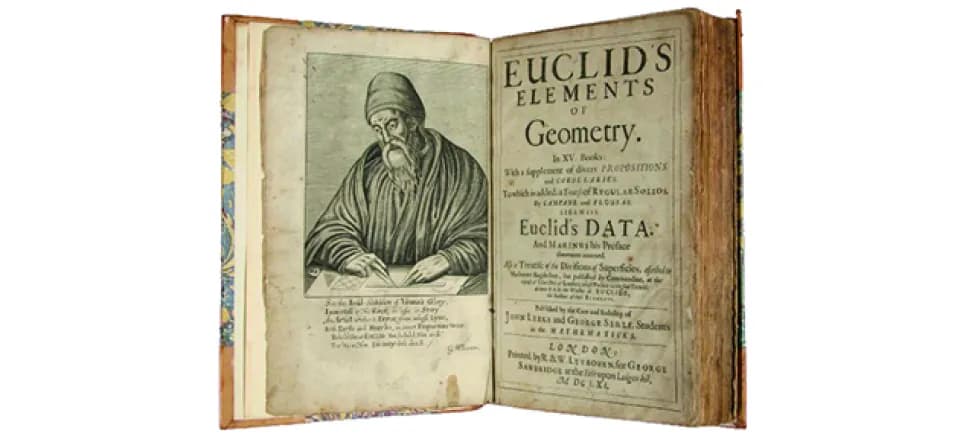
Working backwards within a given theory, we can retrace the chain of every proof until only the original premises remain. Since the chain is finite, we inevitably reach statements that must be accepted although no proof can be provided for them: the axioms.
-
Self-evident truths? Not always!
--------------------------------