



The art of numbers
We now talk about "Arabic numerals" but we often completely ignore the successive or competing notation systems that were used in Islamic countries. Similarly, it is said – and readily repeated – that algebra was born with al-Khwārizmī, and one sometimes knows that he was interested in inheritance questions to refine his solving methods, but who has ever looked at the exact way he approached them? We also often forget all the other mathematicians, particularly those who came later, who structured algebra over the centuries. And one should not neglect all the development of arithmetic, especially recreational, which could pervade many texts sometimes with no apparent connection to mathematics.
All articles in this folder
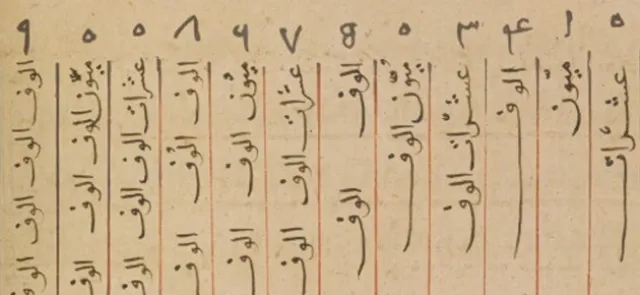
How Arabs wrote numbers in the Middle Ages | Tangente
Today, we use "Arabic numerals" to refer to what the Arabs themselves called "Indian numerals." Other numeral systems predated these numerals—the ancestors of our own—and even continued to coexist with them after their introduction.

Dividing inheritances under Islamic law
Dividing an inheritance may seem like a mathematical question of little interest. Yet al-Khwarizm devoted a large part of his work to it because he saw it as an ideal playground for algebra.
Al-Zanjānī: teaching algebra in the 13th century
What we now group under the term "algebra" took time to develop into a discipline in its own right. Al-Zanjānī, the author of a 13th-century educational treatise, provides valuable evidence of the algebraic methods used in his day.
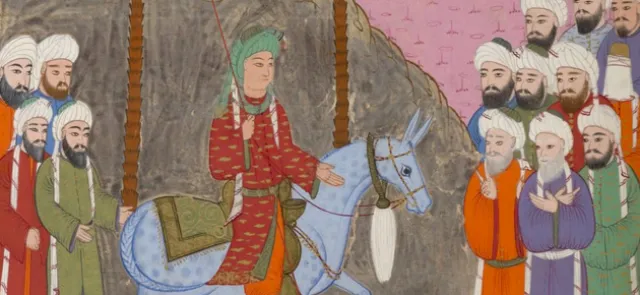
Recreational problems from the Arab-Islamic world
Mathematical recreations feature prominently in the Arab-Islamic tradition, yet they do not appear to have been collected in dedicated anthologies. Some examples, very well known in Europe, pose a real challenge to historians seeking to trace how they circulated.