



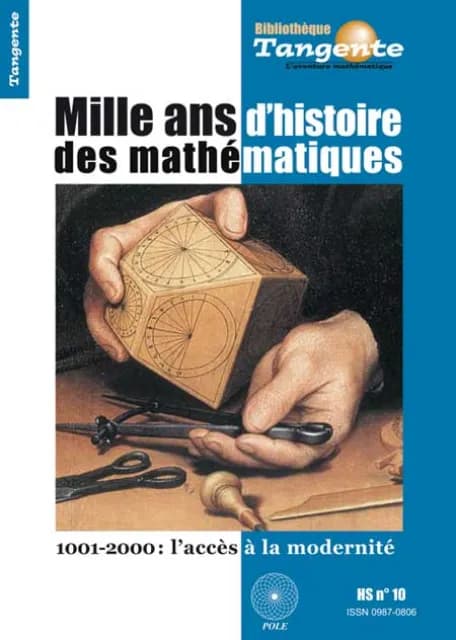
Magazine
1000 years of maths history
January 1, 2005
- Number
- 10
- Published
- January 1, 2005
- Pages
- 160
- ISBN
- 9782848840291
- Price
- €22.00
About this book
CONTENTS
Intro: The steps of a millennium
After the ebbs and flows of ancient periods, the second millennium of our era is characterized by continuous progress in the fields of knowledge and mathematics in particular. A detailed study however reveals great epochs and a rhythm in history.
Numerology, the esoteric temptation
File 1: History of ideas: the classical era
To describe natural phenomena, Newton invents infinitesimal calculus. Judged not rigorous, the notion of the infinitely small was eliminated by Cauchy and will only be reintroduced very recently in non-standard analysis. Galois, for his part, makes a major contribution to the mathematics of his time and those that followed.
Newton... and physics became mathematical / The infinitely smalls: actual or potential' / Évariste Galois: unrecognized genius' / A short history of mathematical recreations / The invention of real numbers
File 2: New trends From an 18th century where Voltaire nicknamed God "the great clockmaker". Similarly, the very regular curves of mathematicians fail to model certain natural phenomena: fractal geometry must be invented. Finally, computers give rise to other fields of study such as automata.
Seven challenges for a millennium / Modern logic from Boole to Gödel / Chaos: greatness and misery of the linear / Fractal geometry / Automata: maths above all
File 3: Evolution of techniques
Practical, fast, efficient: our current numbering system is the result of a slow maturation from the Arabs until the Middle Ages. This step was necessary before starting to calculate with letters, to do algebra. By inventing the coordinate systems that bear his name, Descartes then reduced geometry to algebra. Always keen to avoid or simplify calculations, mathematicians invented logarithms, or later symbolic computation software.
Symbolism and Arabic mathematics / Middle Ages: decimal numeration prevails / Viète: the birth of literal calculation / Descartes' coordinate system / From logarihms to logarithm / Symbolic computation: future of mathematics? / Mortality tables in the 17th and 18th centuries
File 4: The great problems Why did the Greeks favor the ruler and compass for the construction of curves? whatever the real reason, this choice has marked mathematics to this day. Another legacy of the Greeks, arithmetic will only see its true advent with Pierre de Fermat, famous thanks to the problems he solved, but also to the one that could only be proven recently and bears his name.
Construction with ruler and compass / Solving algebraic equations / Probabilities: multiple paternity / Fermat or the advent of arithmetic / Prime numbers / The fabulous number ???? / Impossible problems / The circle finally squared
And always
In brief - problems - solutions