



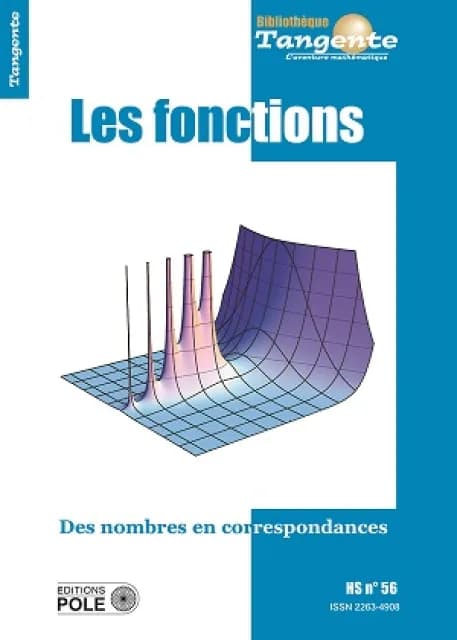
Magazine
Functions
May 17, 2016
- Number
- 56
- Published
- May 17, 2016
- Pages
- 160
- ISBN
- 9782848841991
- Price
- €22.00
About this book
The concept of function, omnipresent from the very origins of science, became precise in the 17th century for the needs of physics. It then became possible, thanks to infinitesimal calculus, to study the trajectories, velocities and accelerations of moving objects, like balls... or planets. Physical intuition then had to give way to the rigor of mathematical reasoning. This was the opportunity for Newton, Leibniz and Bernoulli to highlight the concept to build upon: that of functions, precisely!
CONTENTS
A little journey through the ages: from expression to function
Dossier 1: The concept of function
A function f is a process, a "black box", which, starting from an object x taken in a set E, makes correspond another. Trying to formalize precisely this naive idea turned out to be a nice challenge: from the Babylonians to Euler, passing through Newton and Leibniz, no one was able to propose a definition that would gain unanimous agreement!
Function or application / You said "affine"? / Functions + iterations = fractals / Functions in nature / Functions in computer science
Dossier 2: Continuity, differentiability, antiderivative
The concept of the derivative of a function at a point is a concept directly derived from physics, which makes it possible to quantitatively express the velocity of a moving object at each instant. It is not true that every continuous function is differentiable; it is less easy to imagine that there exist continuous functions that are not differentiable at any point!
Local continuity, continuity on an interval / Provocative discontinuous functions / The controversy of vibrating strings / Threshold effect: the aberrations of discontinuity / The intermediate value theorem / From the tangent to the derivative / Often, function varies... / Solving equations: Rolle's theorem to the rescue / Approximations and successive derivatives / Interpolate, extrapolate and approximate: three complementary ideas / A primitive approach to integration
Dossier 3: Curves, graphs, equations
For the Renaissance algebraists, the function is a kind of "magic formula" which makes it possible to obtain a solution to a polynomial equation. With the arrival of coordinates, functions transform into graphics, curves, surfaces... before becoming more abstract.
Curves and functions / Curves for drawing / Algebraic equations: an endless story! / Differential equations and variations / Functions of several variables / When the relation is not well defined: implicit functions
Dossier 4: Name of a function!
Functions are the dynamics of mathematics. They tie relationships between numbers, geometric figures, algebraic structures... Classifying them according to their specificity naturally imposed itself. This nomenclature made it possible to immortalize the surnames of scholars like Euler, Lagrange or Chebyshev.
These essential polynomial functions / Trigonometric functions / Discrete and fundamental: arithmetic functions / Euler and the legacy of his indicator / Monstrous functions! / Series of functions / A new combinatorial approach: generating functions / Random variables / Functions specific to statistics / Functional analysis: operators are in the place / Schwartz distributions
And also
Functions in everyday life / Functions and manipulation / They have a name
And always
In brief - Reading note - problems - solutions