



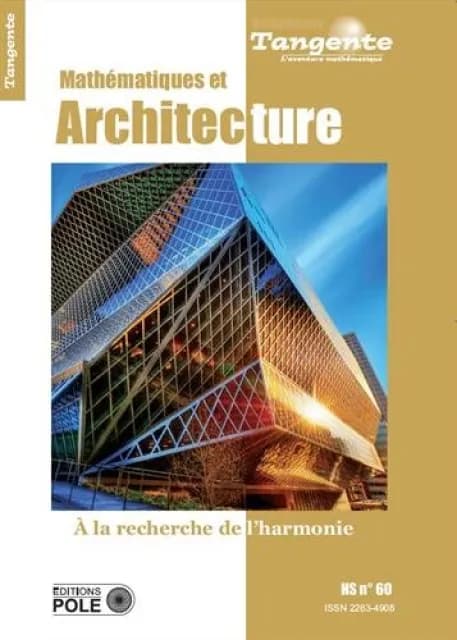
Magazine
Mathematics and Architecture
July 31, 2017
- Number
- 60
- Published
- August 21, 2017
- Pages
- 160
- ISBN
- 9782848842035
- Price
- €22.00
About this book
The work One might expect that the links that have developed between mathematics and architecture would be purely geometric in nature. It is surprising to see that many other domains are also concerned: that of numbers and proportions (where one finds the famous golden number), that of creating precise rational tools, and even that of the trade-off between accuracy and aesthetics.
The collection and authors Bibliothèque Tangente is THE prestigious collection of mathematical culture, the reference for all scientifically curious readers. With more than 50 titles, content carefully balanced to be accessible to the widest audience, a luxurious layout, it offers a new way to discover the world! The Tangente team, led by Gilles Cohen and Bertrand Hauchecorne, includes the best French authors of mathematical popularization.
CONTENTS
Luca Pacioli: the point on De Divina Proportione / Michel Cantal-Dupart's architecture lessons
Dossier 1: The beautiful and the exact
Why would one be obligated to think of architecture's mathematics only from the standpoint of rigor? Imagination has invaded architects' plans. Delimiting the place of aesthetics in construction also means setting the role of each for the benefit of the work.Christopher Wren's two kinds of beauty / The harmony of proportions / Human proportions and the golden number: Le Corbusier / Expo 58 in Brussels / From Art Nouveau to Art Deco / A sphere among the lines: the Geode / Vladimir Chukhnov, the father of hyperbolic structures / The Tower of Babel / Santiago Calatrava: stations, towers and bridges
Dossier 2: The place of mathematics in architecture
Since antiquity, mathematics has been an inseparable partner of architecture. These links, which are based on practical and scientific considerations, have been revolutionized by the arrival of computer tools.
Mathematics and the architect through the centuries / Brunelleschi: a scientific and technical content / Villard de Honnecourt's geometry / Short story: Professor Phi's infernal tower / Yona Friedman, ambassador of the diagram / The architect facing mathematics / Classical works: few mathematical contents… / Vauban and fortifications / Architecture and digital technology, a mathematization of space / Jean-Louis Brahem, an architect inspired by mathematics
Dossier 3: Number, space and form
The choice of a building's form, preliminary sketches and drawings, questions about the relationships between the different dimensions of a construction are fundamental aspects of the architect's approach.
Leonardo da Vinci: math and constructions / Nikos Salingaros's proportions / Visiting a building … in the fourth dimension! / The hidden geometry of Andy Goldsworthy / The world on a drawing: perspective / Richard Buckminster Fuller, a genius polymath
Dossier 4: Useful mathematics
Architecture extends far beyond building construction. Bridges, huts, and scaffolding also derive their solidity from respecting a few rules of mathematical physics.
The metacenter in naval architecture / Suspension bridges / The Greenwich cone / Mathematics serving social solutions / Building with diamonds! / A short history of descriptive geometry / Reinforced concrete and ruled surfaces / Fabien Vienne, geometry through play
Dossier 5: Curves and surfaces
Architecture uses curves and surfaces dictated by the need for solidity of buildings. Thus, in our urban landscapes appear forms with interesting properties, such as circles, catenaries or hyperbolas.
Architectural curves and surfaces / The hyperboloid, friend of architects / History of vaults / From vaults to straightedge and compass / Guimard's surface / Zaha Hadid, architect of the impossible / The catenary, elegance made curve / The Liège-Guillemins station / Some states of the pentagon / Non-standard architecture
And always
Problems and solutions