



Magazine
Set theory
December 15, 2017
- Number
- 61
- Published
- December 11, 2017
- Pages
- 160
- ISBN
- 9782848842134
- Price
- €22.00
About this book
The work
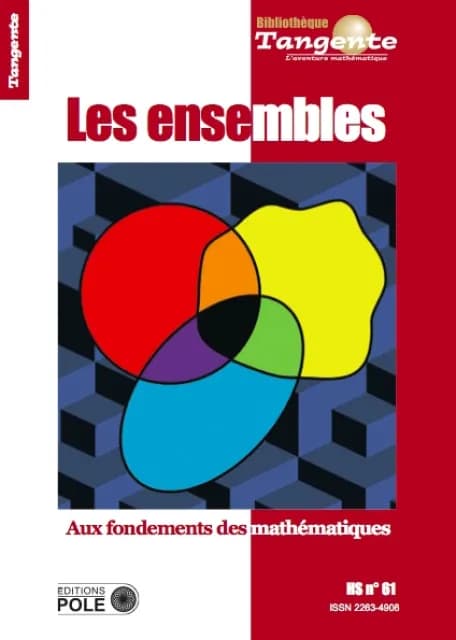
Set theory has left a memory with all those who went through the 'modern maths'. Its axiomatic framework, which some may have perceived as rigid, makes it possible to 'unroll' the entire body of mathematical knowledge. How? This is what this book proposes to discover by lifting the veil on the origin and construction of this theory. Everything started from a deep scientific malaise, the crisis of foundations. The mathematical edifice, which was believed solid and unalterable, was in fact fragmented by contradictions and poorly defined objects! The introduction of sets at the end of the 19th century helped improve the situation, while also giving rise to its share of paradoxes, impossibilities, situations defying intuition... A set is a collection of objects between which various relations can exist. This is how the notions of structures and functions emerge, governing the majority of mathematical concepts. The construction of numbers and a new approach to geometry naturally follow from this. Such conceptual simplicity gives sets and functions a formidable effectiveness! At the foundations of Choosing the right axioms to develop set theory and describe mathematics (and, beyond, all sciences!) is no small task...
The contents
Dossier : History of a revolutionary theory Set theory is the very archetype of a structuring theory. This abstract architecture did not emerge from nowhere: it finds its origin in problems relating to the foundations of mathematics during the 19th century.
The mathematical work of Bourbaki - An approach to mathematics that disturbs - Lewis Carroll, towards modern logic - First uses of sets - The Dobble game - Borges, the Library of Babel - Hilbert's hotel
Dossier : Sets, relations, mappings: a new approach Beyond their naive representation in 'blobby shapes' known as 'Venn diagrams', sets offer a framework for a rigorous formalization applicable to all domains of mathematics.
From collection of objects to the set - The set and its subsets - Squiggly diagrams, an idea that gives us the giggles - Relations and mappings: structuring sets - Dazzling binary relations - The Hausdorff medal - Constructing numbers, a long story - One by one - The names of the elements of a set
Dossier : Operations, structures, numbers Numbers are at the center of the mathematical edifice. After a long reign of intuition, the need for a rigorous axiomatic system made itself felt. The one introduced by Peano to define natural integers is the finest example. Operations, too, fall within a structural framework of great richness.
Kurt Gödel and undecidability - Join groups! - What is a group? - The fractal dimension of the triadic set - The birth of algebraic concepts - The logical algebra of George Boole.
Dossier : Infinity and paradoxes A study of the axioms on which set theory is founded brings to light the notion of infinity, but also paradoxes: can a set be a member of itself? How many types of infinities exist?
A brief history of infinity - Georg Cantor: from the finite to infinity - The multiplicity of infinities - The novel of Lotfi Zadeh - Fuzzy sets: modeling uncertain memberships - John von Neumann, measure and immoderation
Dossier : Axiomatics Set theory is often criticized for its formal, abstract, axiomatic character. Yet, many riches emanate from a general framework that can be declined according to desires and needs!
But what are axioms? - Zermelo's attempt to eliminate paradoxes - The axiom of choice, so natural, and yet so surprising... - The axiomatization of chance - At the sources of topology - Ten problems in blobby shapes