



November 25, 2013
- Number
- 49
- Published
- December 31, 2099
- Pages
- 160
- ISBN
- 9782848841564
- Price
- €22.00
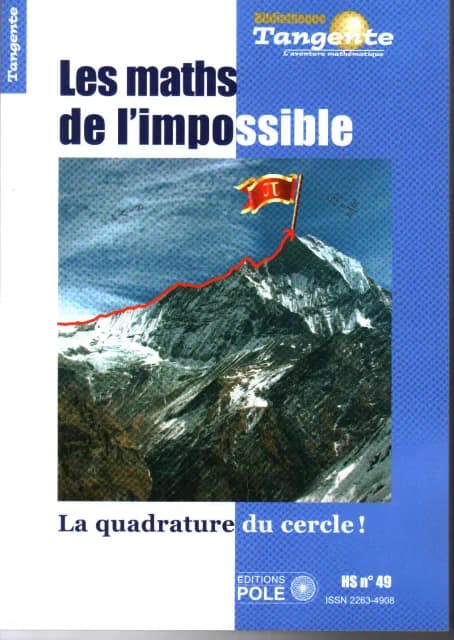
About this book
CONTENTS
Impossible figures' / Littlewood, the mathematician who fraternized with the impossible
Feature: 1 It's impossible, it's been shown!
Many problems dating from Antiquity have been proven unsolvable, even though they were well-posed. Some have become great classics.
Squaring the circle / The trisection of an angle / Is impossible geometric? / Impossible gear ratios: how not to break your teeth / Some complex imaginaries / When elementary systems are impossible / Impossible linear systems and generalized inverses / Raymond Queneau and equations of degree 5 / A paradoxical yet rigorous dissection / Impossibility theorems related to elections / Impossible numerical algorithms
Feature 2: Variations around the notion of proof
Sciences often progress by posing questions that reflect their author's intuition. In mathematics, these questions are called conjectures. Sometimes proofs are provided, but so difficult to reproduce that doubt remains about their validity. Computer tools can then be of great help.
The notion of axiom through the centuries / The particular status of conjectures / The great conjectures / Gödel's impossibility: the end of a dream / Unacceptable proofs? / The great theorems / The monumental Feit-Thompson theorem receives a formal proof / When calculations become impracticable
Feature 3: They exist, but where are they?
In mathematics, it is possible to prove that objects exist without ever exhibiting them. We then speak of non-constructive proofs. This raises from a new angle the question of existence in mathematics: is it enough to define a concept to give it life, or must one explicitly construct it?
The scale of mathematical existence / Impossible, probability-zero events? / Nilpotent infinitesimals for analysis / Inverse functions / Implicit functions
Feature 4: Playing with the impossible
It is easy, if one is not careful, to fall into the trap of a subtly erroneous reasoning. Several paradoxes are based on such manipulations. Curious minds then explore the consequences of the rules of logic, for example to solve an apparently impossible problem that seems to be missing all the data.
The impossible problem / An impossible problem and yet solvable! / Magicians father to son / Paradoxes and paradoxical proofs / Unexpected bijections / We'll take a little tour... in base 4 / These extraordinary filling curves / The two-colored tokens / The equality of all reals or the target tax theorem / Impossible, even for an omnipotent God' / Ramsey's socks / The three dice
And always
in brief - reading notes - problems - solutions