####

The daughter of Éric Trouillot, creator of the hit game Mathador
and a great friend of the editorial team, has made her mark!
A year that comes full circle
----------------------------
In 2022, the digit 2 will undoubtedly take center stage.
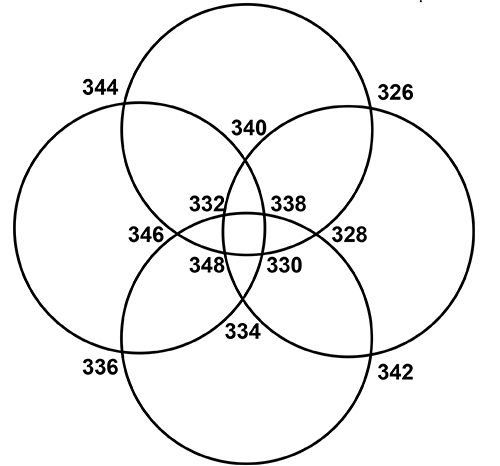
But so will 2 + 0 + 2 + 2 = 6 (that is, 3×2 = 6), mathematician and magician Dominique Souder tells us. In the diagram he devised, the twelve values shown at the intersections are the terms of an arithmetic sequence with common difference 2, starting at 326.
On each of the circles in the four directions, add the six values we encounter… what do you get?
Using consecutive integers
----------------------------
In the "Affaire de Logique" column of the daily newspaper Le Monde, its authors, Élisabeth Busser, Gilles Cohen and Jean-Louis Legrand, upheld tradition by suggesting, for example, that 2022 be written as a sum of consecutive integers:
2,022 = 673 + 674 + 675, or 2,022 = 504 + 505 + 506 + 507, or even 2,022 = 163 + 164 + … + 173 + 174.
To find such sums, observe that the sum of the integers from A to B is the sum of the integers from 1 to B minus the sum of the integers from 1 to A – 1. Here, this gives }{2},) which leads to 4,044 = (B+A)(B–A+1). We then write 4,044 as a product of two integers; the only suitable factorizations are 3×1,348, 4×1,011 and 12×337.
For example, this gives 2,022 = 3×(1,348/2), that is, 3×674,
or 673 + 674 + 675.
This time, using consecutive digits, we can also write 2,022 using as few digits as possible (and therefore excluding an initial 0). Using no signs other than + or –, we find 2,022 = 1,234 + 5 – 6 +789. Allowing all operations except factorial and using progressively more digits, we can propose:
2,022 = (1–2+3)×(45–6–7), or (1+2)(3+4) – (5+6)×(7+8), or even 1 + 2 + 3 + (4×(56+7)×8), or, using all nine digits, (1 + 2 + 3)×((4 – 5 + 6×7)×8 + 9).
Using all operations, including factorial, François Lavallou and Alain Zalmanski, both champions in this field, found:
2,022 = –1 + 2 + (3!)4 + 5 + 6!,
or (1 + 2)!!×3 – 4! – 5! + 6,
or finally 1 + 2 + 3 – 4!×(5!+6) + 7!.
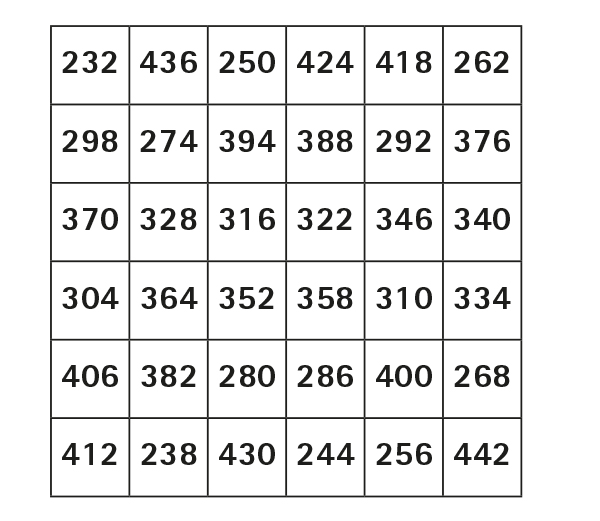
Finally, to stay with arithmetic, mentalist Benoît Rosemont devised the following magic square, whose countless properties will not escape you (those of the 2021 magic square were scrutinized by René Descombes; see Tangente 202, page 2; feel free to draw inspiration from them!).
More unusual still
--------------------
The number 2,022, the product of 2, 3 and 337, has many other properties that our colleagues and friends have also noticed. It was noted, for example, that the square of the digit reversal of 2,022 is also the digit reversal of its square (in other words, 2,0222, which is 4,088,484, is the digit reversal of 2,2022, whose value is 4,848,804). But this was also true of 2,021… and will no longer be true of 2,023.
Admittedly, 2,022 is not a palindrome… in base 10. But, as Alain Zalmanski, a keen palindrome enthusiast, points out, it is one in base 18 (where it is 646) and in base 43 (where it is 141).
To end on a high note, Michel Criton even tells us that 2,022 is the first term in a sequence of four consecutive Harshad numbers (numbers divisible by the sum of their digits).
Specifically, 2,022 = (2 + 2 + 2)×337, 2,023 = (2 + 2 + 3)×289, 2,024 = (2 + 2 + 4)×253, 2,025 = (2 + 2 + 5)×225. A pleasing pattern!