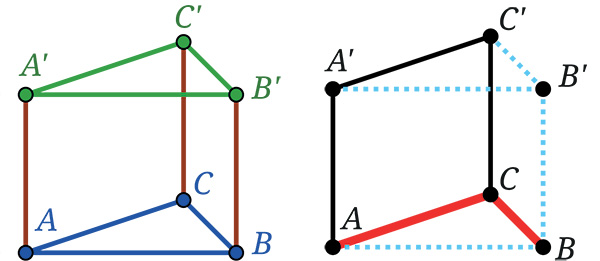
Take a graph G—a collection of vertices connected by edges—as the lower bunk. Take a second copy G' of the same graph as the upper bunk. All that remains is to connect each vertex of G to its counterpart in G' to obtain a "bunk bed."
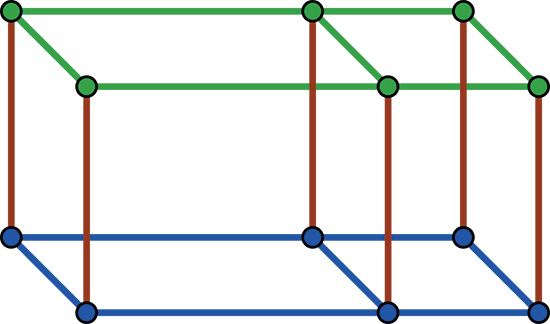
Two copies of the same graph are connected to form a "bunk bed."
A fun game is to delete each edge of the "bunk bed" with some fixed probability p, chosen in advance, and see which paths remain. Take a triangle ABC as the lower bunk, connected to a triangle A'B'C'. This gives 512 different graphs, and when p = 1/2, all these configurations are equally likely. Of these graphs, 362 contain a path from A to B, but only 307 contain a path from A to B'.