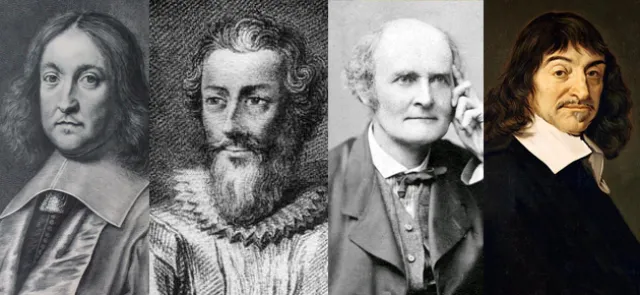
In 2000, he published his first book on the subject (Les carrés magiques – Histoire, théorie et technique du carré magique de l’Antiquité aux recherches actuelles. Vuibert), followed by several more. Nor has that stopped him from continuing his research. He still has a wealth of unpublished material available on his website (**canal-math.com**).
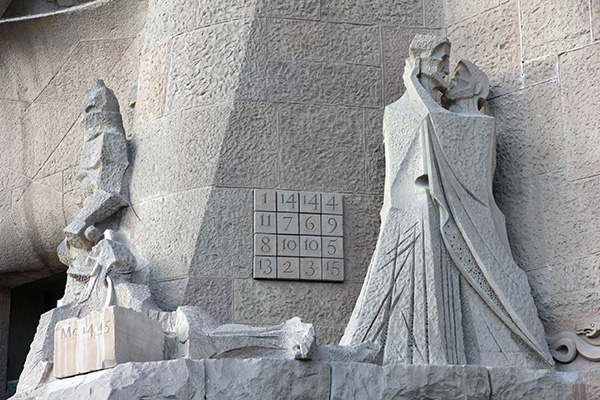
The Sagrada Familia magic square (Barcelona, Spain).
A passion
-----------
Tangente : How did this passion for mathematical questions begin and develop?
René Descombes: I believe I encountered figures from a very early age. My father was a chartered surveyor. For a time, he worked in forestry, where one of his particular responsibilities was calculating timber volumes. For many years, I kept a small Traité du cubage des bois (Treatise on Timber Volume Measurement). I was probably struck by those endless columns of digits and numbers.
Later, when I was about fifteen, I discovered Gaston Boucheny’s book (Curiosités et récréations Mathématiques, Librairie Larousse, 1939) in my middle-school library. I was fascinated by its contents. I remember poring over the few pages devoted to magic squares at the end of the book. I was amazed that one could construct thousands, millions of different magic squares—infinitely many! I made numerous attempts in my rough notes. During my studies, I set recreational mathematics aside, but my interest in numbers remained and never faded throughout my working life.
It was only when I retired in 1987 that I rediscovered my taste for recreational mathematics, particularly magic squares. I cannot really explain why. I probably needed something to fill those first years of newfound freedom and regained time.
Lucien Gérardin’s book (Les carrés magiques - Mystérieuse harmonie des nombres, Dangles), published in 1986, was probably my bedside companion during those years.
I became truly passionate about this subject, whose origins stretch back to the dawn of time. My friends poked a little fun at me for this passion, which struck them as incongruous and entirely unconnected with the real world.
Palindromes and magic squares
------------------------------
After studying alpha palindromes (see page 28), René Descombes turned his attention to constructing magic squares of alpha palindromes.
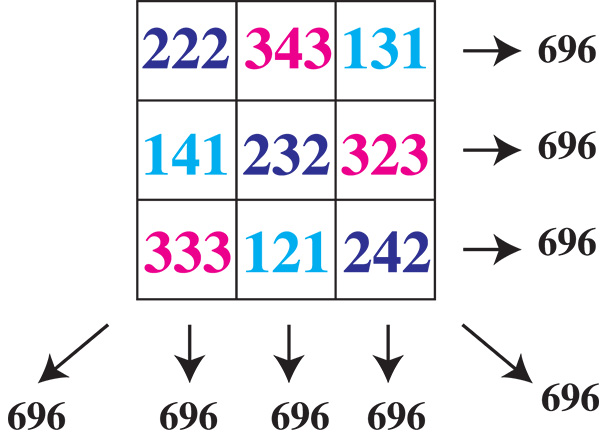
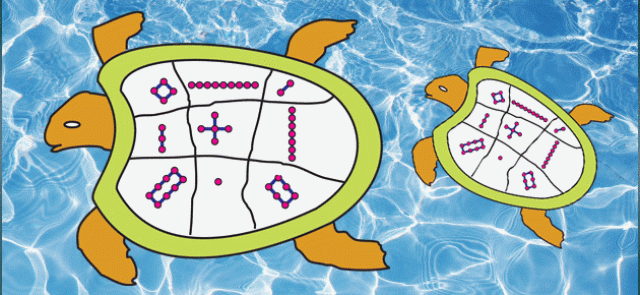
His method is as follows. He takes a magic square as a catalyst—in other words, as a model. For a 3 × 3 square, the natural catalyst is the Lo Shu, the unique 3 × 3 magic square, up to rotations and reflections. He then takes three successive series of alpha palindromes—for example, {121, 131, 141}, {222, 232, 242} and {323, 333, 343}—and places them in the same pattern as {1, 2, 3}, {4, 5, 6} and {7, 8, 9}.
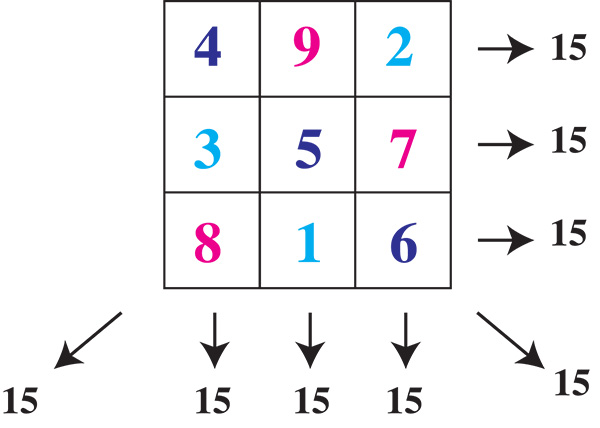
Lo Shu (catalyst).
This produces a magic square of palindromic numbers—and, as icing on the cake, its magic sum is a palindrome too! We leave readers to verify that doubling every number does indeed produce a magic square of palindromic numbers. Magic squares of alpha+ palindromes can also be constructed: these are palindromic numbers n such that 2n + 1 is also a palindrome.