The "Blake and Mortimer" comic-book series may have been a childhood favourite of yours. Created in 1946 by Belgian artist Edgar Félix Pierre Jacobs (1904–1987), who was also one of Hergé's collaborators, it follows the adventures of Captain Francis Blake, a former Royal Air Force pilot, and Professor Philip Mortimer, an expert in nuclear physics. Science and science fiction feature frequently in the series, which now comprises eighteen adventures published across twenty-four albums by Éditions Blake et Mortimer and has lived on since 1987 thanks to the talents of several artists and writers. The best known were Robert Frans Marie De Moor (known as Bob de Moor), Jean van Hamme, Thierry Benoit (alias Ted Benoit), Yves Sente, André Juillard, René Sterne (born René Vanpijperzeele), Chantal De Spiegeleer, Aubin Frechon (better known by his pen name Antoine Aubin) and Étienne Schréder.
As is often the case in comics featuring top-flight scientists, mathematics receives only scant attention in the scientific discussions (see Tangente 142). So what was Professor Mortimer's relationship with maths?
Rockets, satellites and trajectories
==================================
A few years ago, a blog devoted to comics offered this thought: "What if Francis Blake had never joined the military, and Philip Mortimer had been hopeless at maths?" So Tangente investigated.
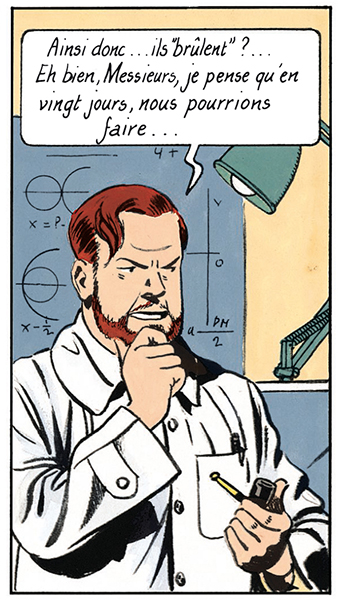
Let's briefly retrace Professor Philip Mortimer's scientific career, particularly its mathematical side. In 1950, in a story by the master himself, Edgar P. Jacobs, he saves the planet from tyranny by building an extraordinary rocket plane, the Espadon. Most astonishingly, he accomplishes this technical feat through mental arithmetic and geometry (see the first illustration), using mainly circles and straight lines!