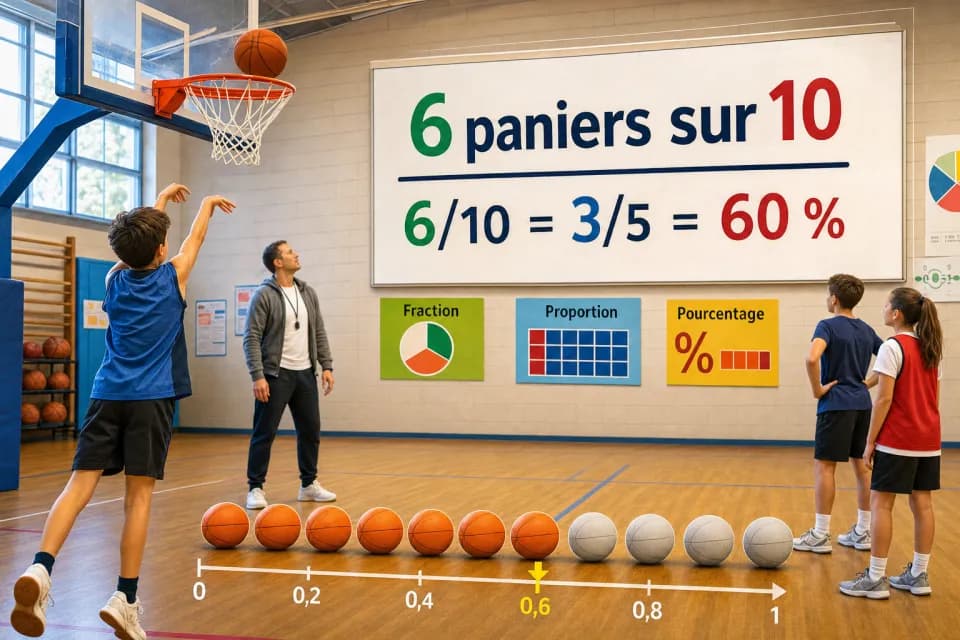
Imagine a math class where the right answer isn't written — it's heard in the sound of a ball bouncing on the court. Ten shots at the basket, six made. How much is that? Not "six", no: six tenths. Or 3/5. Or 60%. Three ways of saying the same thing, and this time the body remembers it.
This is the bet placed by a team of Norwegian researchers, who published, in Educational Psychology Review, the results of a pedagogical intervention as simple as it is unexpected: integrating fractions into physical education classes through basketball exercises. The name of the project? Basketball Mathematics — to be pronounced with the enthusiasm of someone who has just sunk a basket from downtown.
309 students, two schools, eight weeks
The study is precise about what it is — and what it isn't. Conducted in two schools near Oslo, it involved 309 Norwegian students aged 11 to 13. Over eight weeks, with one sixty-minute session a week, 184 of them followed the Basketball Mathematics program. The other 125 formed two control groups: one practicing ordinary basketball, the other following a standard PE class.
The result is clear-cut. By the end of the intervention, the Basketball Mathematics group had improved by 15% on fraction questions compared with the control groups. And the bonus doesn't stop there: an additional 5.4% improvement was measured on math questions with no direct link to fractions. As if learning to think in proportions had rippled out to nourish other corners of numerical reasoning.
This is what the University of Copenhagen press release sums up with the frankness of a researcher who doesn't want to oversell: "These are fairly substantial improvements over a short period", acknowledges Jacob Wienecke, associate professor of sports science. But he immediately adds the sine qua non condition: "The key is that the movement makes sense in relation to what the students are supposed to learn — that they don't just solve an exercise and then run a lap around the field."
Why the body helps the brain grasp 3/5
Fractions are, as Andres S. Bustamante and his colleagues note in their study of a related program called Fraction Ball, "notoriously difficult for elementary school students". This is no coincidence. A fraction is not two numbers stacked on top of each other: it is a quantity, a point on a number line, an amount that can be compared with others. Robert S. Siegler, Clarissa A. Thompson and Michael Schneider formalized this in an integrated theory of numerical development: the difficulty of fractions often comes from children improperly transferring the properties of whole numbers — expecting, for instance, that multiplying always makes a number bigger.
The basketball court, for its part, produces concrete quantities. Six shots made out of ten is a proportion you can see — six balls in the basket, four on the ground. The fraction 6/10 is no longer an abstraction: it is the result of an action the body has just performed. This is what researcher Manuela Macedonia calls learning through the body (embodied learning): in a review published in Frontiers in Psychology, she shows that "the body — through action and gesture — is a powerful tool for understanding and learning school subjects", particularly in mathematics. The condition remains the same: the gesture must be semantically linked to the concept, not simply attached alongside it for motivation.
This is precisely where the elegance of the Norwegian program lies. The students don't do math after sport. They do math with sport. Every shot produces a data point. Every data point becomes a fraction. Every fraction is written, simplified, converted into a percentage — and placed mentally on a number line running from 0 to 1, a tool the What Works Clearinghouse panel of the Institute of Education Sciences explicitly recommends as the central representation in fraction instruction.
Try it at home — all you need is a ball and five minutes
You don't need a gym. A wastebasket, a paper ball and a hallway are enough. Here is the exercise in its minimalist version:
This last point is the heart of the problem. Comparing 3/10 and 4/10 is immediate. Comparing 3/10 and 2/7? That takes thought. And this is exactly where the concept of fractional magnitude comes into play — because your body has just experienced these two proportions, the comparison is no longer purely symbolic.
A real effect, but open questions
Let's be honest about what the study proves — and what it does not yet prove. The intervention lasted only eight weeks. The researchers themselves point out that the Basketball Mathematics group benefited from an extra weekly session of mathematical content, even though total school time did not increase. In other words: part of the effect could simply be down to spending more time on fractions, in whatever form. Whether the gains persist over time remains to be shown — the team plans to extend the follow-up.
What can be said with confidence: students in the intervention group reported greater motivation, engagement and a sense of mastery during the sessions, according to the university's press release. Their slalom dribbling skills improved just as much as those of the basketball-only group. And a teaching pack was developed, freely available to teachers who would like to try the experiment.
The real question, for a French teacher reading these lines, is not "does it work?" — the data says yes, at least in the short term. The real question is: "How do you build the link between the gesture and the concept, so that one truly illuminates the other?" This is a problem of pedagogical design, not motivation. And it is, in itself, a beautiful mathematics problem.
Key takeaways
The fraction as a point on a line: what cognitive research really says
Why are fractions so difficult? The most solid answer comes from a theory proposed by Robert S. Siegler, Clarissa A. Thompson and Michael Schneider, published in Cognitive Psychology: children arrive at fractions with intuitions forged on natural numbers, and these intuitions systematically betray them.
Let's take an example. With whole numbers, multiplying always makes a number bigger, dividing always makes it smaller. With fractions, multiplying by 1/2 gives a result smaller than the starting value. Half of 8 is 4 — and yet we have "multiplied". For a student who has never thought of fractions as quantities, this statement is a pure paradox.
The solution, according to Siegler and his colleagues, is to build a representation of fractional magnitude — that is, to learn to place 3/4 or 5/6 on a number line running from 0 to 1, even before knowing how to add them. A fraction is a real number like any other: it has a precise place, it is bigger than some and smaller than others.
Within this framework, the basketball court can be read as an embodied number line. The distance between absolute zero (no shots made) and absolute one (every shot made) is physically traveled, session after session. Each score occupies a position on this interval. And the student who compares their performance from week to week — 4/10 the first time, 6/10 the second — is doing exactly what numerical cognition researchers recommend: ordering fractions, perceiving their relative distance, building a sense of magnitude.