Cédric Aubouy, math clown and author of “Je ne sais pas”
Cédric Aubouy, the man who did not know
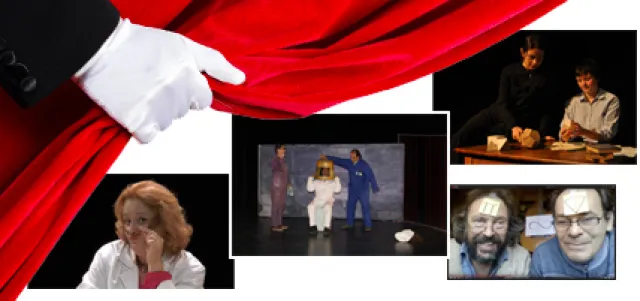
Cédric Aubouy, a mathematical clown and founder of the L’île logique company, agreed to meet us to mark the publication of his first novel, Je ne sais pas ou la disparition des mathématiciens.
Tangente: Your latest book, Je ne sais pas ou la disparition des mathématiciens, came out this summer. What is it about?**
Cédric Aubouy: It is a burlesque journey through the history of mathematics and the birth of computing, from the early 20th century to the present day. The story rests on the rather outlandish idea that a recursive formula had supposedly been discovered—and kept secret—in order to transform every problem in NP into a problem in P, with the consequences this would have for encryption today (the novel is set in the present). But the narrative also touches on several results in logic, arithmetic, geometry and set theory, along with some entertaining little puzzles. That said—and this matters a great deal to me—readers need no mathematical background whatsoever, and they can easily follow the adventure without necessarily understanding the mathematics they encounter. Of course, I wrote this book to delight maths enthusiasts, but above all I wanted to captivate curious readers wondering where to begin lifting the veil on a world that, from a distance, can seem rather mysterious.
Je ne sais pas is a novel. Why did you choose this form?
Because it lets you enter the realm of the imagination. With L’île logique, my company devoted to burlesque theatre and mathematical clowning, I have written more than ten plays. It is always a pleasure to plunge into absurd worlds before turning to mathematical rigour, so I simply carried on in that vein. Mathematics, for example, has one remarkable advantage over physics: it can break free from reality and sail off into surrealism. The ship’s captain can quite happily be 3,500 years old, and if 17 cakes eat 51 children, each cake will eat three children and all will be well…
Can you explain this intriguing title?
I don’t know… But without giving anything away, let’s say it is a positive feedback loop tied to the story, one that you will understand as you read. And as for the subtitle: AI, something is afoot…
One last, more general question: what does mathematics mean to you?
Oh, that’s a vast question! Without departing from the usual definition involving abstractions, relationships, numbers or points, I would say that mathematics can be approached in three ways: historically, through childhood and in its present-day form. We can view mathematics through the evolution of human thought, from calendar and lunar calculations and notions of exchange or sharing—arithmetical or geometrical—to the contributions of the Chinese, the Greeks, the Arabs and then the West. Or we can see it through a young Homo sapiens’s encounter with the subject: recognizing shapes with an activity cube, for example, then learning to count, infinity slowly coming into view, followed by school—where everything is Euclidean, unlike reality…—and finally the modern practice of mathematics, with the axiomatic method, the presence of computing (constructivist mathematics), and even AI, which is poised to surpass us…